Facebook Blogging

Edward Hugh has a lively and enjoyable Facebook community where he publishes frequent breaking news economics links and short updates. If you would like to receive these updates on a regular basis and join the debate please invite Edward as a friend by clicking the Facebook link at the top of the right sidebar.

Thursday, May 14, 2009

The ECB "Buys Into" Spanish Property


“The 60 billion euros they announced is peanuts for an economy the size of the euro zone,” economics professor and former Bank of England policy maker Willem Buiter said at a conference in Dublin yesterday. “I expect they will announce more or that the recession in the euro zone will be longer and deeper than would otherwise be necessary. They have a record of being somewhat behind the curve.”
European car sales dropped 12 percent in April.... Bayerische Motoren Werke AG’s registrations dropped by almost one-third to 55,633 even as the German market expanded 19 percent, helped by the government’s 2,500 euro ($3,400) sales bonus .........Spain extended its auto-sales slump with a 46 percent plunge in registrations, the largest among the continent’s main markets, while U.K. sales dropped 24 percent. Eastern European registrations dropped 21 percent, almost twice the rate of decline in the west, as Romanian demand fell by more than half.

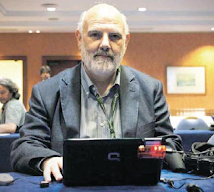
The title to this post, and the accompanying photo are obviously a joke. But behind every joke there lies a grain of truth, and my present one is no different from all the rest in that sense, since the ECB is now indirectly buying into a piece of the Spanish property action, and they are about to do so by the acquisition of an instrument known generically as "covered bonds", the purchase of 60 billion euros worth of which was announced by the ECB last week, much to the surprise of the assembled press conference journalists, many of whom either couldn't believe or couldn't understand what they were hearing (see transcript extract below). These instruments may be generically known as covered bonds, but in Spain we call them cédulas hipotecarias.

The only covered bond most of the journalists who attended the press conference seem to have been aware of, however, was the German one - known as Pfandbrief - and hence the move was seen as some sort of "sweetner" for a fairly reluctant Bundesbank. In fact things are rather different, since, although the Pfandbrief do form part of the picture, via in particular the Hypo Pfandbrief Bank of troubled German Hypo Real Estate, in both Spain and Ireland some form or other of covered bond is to be found at the heart of the wholesale money financing strategy invented by the banks (in the early years of this century) when they realised that bank deposits alone were not going to prove sufficient if they wanted to make good on all the mortgage provision opportunities the low interest rate policy (2%) being pursued by the ECB was creating. As it happens, I have long taken an amateur's interest in the subject of covered bonds (and cédulas hipotecarias), in fact I got interested in them just as soon as I realised what an important part of the Spanish picture they were. You can find a convenient summary of what they are, how they work, and why understanding them is important if you want to get to grips with the current Spanish crisis here.

Really, and to cut a long story short, refinancing the cédulas has become important since they were originally issued on a short term (5 or 7 year duration) basis (presumeably to keep debt servicing costs down), but since they were matched against mortgages which were issued with a 20 to 30 year maturity, they were always going to need rolling over (and over, and over), and again, since the quantity of money involved is large (anywhere between 250 and 300 billion euros between now and 2014 at a guess), and since virtually nobody has wanted to know about buying them since the US sub prime crisis broke out in August 2007, they had become a big potential headache for the Spanish authorities, with something like 50 billion euros in the current Spanish bank bailout programme being earmarked for easing the renewal process.

Indeed so important have the cédulas been that you could virtually say that the current Spanish crisis was inaugurated in September 2007 when the wholesale money markets were closed to the Spanish banks who wanted to sell them, even if after hours and hours of talk-show debate (and miles and miles of column print) devoted to the crisis, hardly any Spanish voter knows what they actually are.

Well, to cut a very long story short, the good news is that the refinancing issue is now probably (and bar the shouting, and the details) as good as resolved, so if you haven't the time, interest or inclination to get involved in more of all the detail on this I suggest you now jump to the conclusions section, were I muse a little bit on what some of the political counterparty consequences of this new level of risk assumption by the ECB are likely to be.


Quantitative Easing, Financing Spanish and Irish Mortgages, Or What?

Basically, most observers have now spent the best part of a week looking into the tea leaves and trying to discern just what it was which lay behind last Thursday's announcement. So peculiar was the announcement (or at least the manner in which it was made) that Bloomberg even have an article headlined "Covered Bond Market Seizes On Plan For ECB Purchases", which explains how the complete confusion now reigning in the secondary market for these instruments (due to the incredible uncertainty over what securities policy makers will actually buy, how they will pay for them, and how great the final quantity purchased will be) has meant that trading in the bonds has all but ground to a halt (again). And this as a consequence of a move which was intended to support the market is a strange result, to say the least.

The initial confusion has only been added to by recent public disagreements between governing board members, and the statement from European Central Bank council member Marko Krnajec (governor of Slovenia's central bank) to the effect that the bank is likely to increase its asset- purchase program from the initial 60 billion euro plan provoked immediate reaction, in particular from Germany’s Axel Weber, who opposes outright asset purchases and has been pushing for the ECB to set an interest-rate floor beyond which they will not reduce further. Indeed Weber was very explicit in reaction to Krnajec yesterday, saying that he sees “no need” for the ECB to buy further private assets to support lending. “I currently don’t see the need for outright purchases of further private debt obligations,” he is quoted as saying. (Joellen Perry at the WSJ Blog has a piece covering similar gound, as she says, maybe ECB predictability has now become the main victim of the crisis, while Claus Vistesen makes basically the same point in his ECB Communication - All at Sea? and his Quantitative Easing à l`ECB? posts.)

The dispute goes even further, and extends not only to what to buy, and how much, but even to how to pay. Kranjec on being asked how the ECB planned to fund its debt purchases, said: “This has yet to be agreed. As a central bank we are creating money. We have no limits with funds to finance projects.” While Weber told journalists tersely: “Note well: It’s not our goal simply to print money.”

The new uncertainty about the ECB’s actions may be undermining market
confidence at a crucial moment. An ECB report Wednesday suggested reviving
investor confidence is key to kick-starting bank funding markets that have dried
up amid the crisis. Lacking steady access to traditional funding sources such as
bond and inter-bank lending markets, the report said, European banks could
curtail lending to households and firms, dampening economic growth.
Joellen Perry, Wall Street Journal Blog


So what is the goal? This is really the key issue, and trying to follow the ECB's ruminations in this sense is more akin to watching a mystery play unfold (in every sense of that expression). Well, where do we look for clues? I can think of no better way than by examining the question and answer to-and-fro Trichet himself had with the journalists in the press conference. So here we go, lets see if you can make sense of all this. The issues are, remember:

a) Does the decision to buy covered bonds constitute quantitative easing?
b) If it is quantitative easing, is it to ease credit, or fend off deflation?
c) Why was the decision taken now?
d) Will the ECB "print money" to finance the purchases, or will the acquisitions be "sterlised"
e) Why covered bonds as opposed to, say, commercial paper?


***********************************************************************************

"The Governing Council has decided in principle that the Eurosystem will purchase euro-denominated covered bonds issued in the euro area. The detailed modalities will be announced after the Governing Council meeting of 4 June 2009."
Jean Claude Trichet, Speaking at the Press Conference Following the Rate Setting Meeting, 7 May 2009.

Question - My second question comes back to the covered bond issue. I wondered if you could explain your general rationale behind this specific asset class? And in that vein, if I can recall correctly, covered bonds are mainly used by the banks in which a lot of German is spoken for refinancing, and not so much in the rest of the euro zone. So are you not implicitly delivering an advantage here to banks that use this particular asset to refinance?

Trichet - On the covered bonds, I remind you that we are in the euro area of 329 million people, this is a single market with a single currency, and what we are doing is what we judge appropriate for the single market with a single currency. All of us in the Governing Council are striving to take the right decisions expected by the 329 million fellow citizens. Covered bonds were considered by the Governing Council as a segment of the private securities markets that in general has been particularly affected, more so than others, in terms of the impact of the financial turbulences.

Question - Firstly a question on the covered bonds. Can you tell us how you came to the figure of around €60 billion? Is that some estimate of the amount of stimulus you feel you ought to be injecting into the economy? Is that what your thinking was? And secondly how are you going to pay for this? Will the purchase be sterilised or can we write that you are going to be printing money?


Trichet - On your first question, I give you a rendezvous for the next meeting when we will discuss all the technicalities for this operation, which is new for us and which calls for appropriate handling. Around €60 billion is only an order of magnitude, appropriate for attaining our goal, to help to revive this particular segment of the market.

With regard to sterilisation, it is included in the question of the exit strategy. I mentioned in the introductory remarks that we consider this issue as absolutely decisive. We have to be up to the present exceptional circumstances. And I don’t want to repeat all the areas where we were the first central bank to act and to take bold decisions. Whether it was the longer-term refinancing of commercial banks, or at the beginning of the turmoil being the most forthcoming central bank as regards its collateral framework, or when we had to take bold action in particular at the very beginning of the turbulence on 9 August 2007. As regards today’s decision taking into account all elements we considered that we could and we should go beyond what had been until now our main channel for enhanced credit support mainly by the refinancing of commercial banks which has, by the way, produced important results. I would like to mention en passant the figures which show that thanks to the decisions we have taken so far - they don’t incorporate of course the new decision taken today - our one-year money market has lower interest rates than in the sister central banks’ money markets. This is also the case at least with one sister central bank for the six- and the three-month money market interest rates. One has to take into account everything, and in particular our handling of our own money market with our full allotment, fixed interest rates procedure, the very forthcoming attitude we have as regards longer-term refinancing, which has even been enlarged today and the collateral that we accept. That being said the Governing Council considers sterilisation and the exit strategy absolutely essential to maintain the maximum amount of credibility in the medium and long term. The public debate emerging on whether or not some central banks are paving the way at the global level for future inflation is extraordinarily counterproductive. We, central banks – and I’m sure that we are all in agreement on this – are determined to solidly anchor longer-term expectations and eliminate these fears about future inflation.


Question - Just again on covered bonds. I understand that you are not ready to answer the question of how these purchases will be financed, but perhaps you could give us an idea of the reasoning behind that decision. Are you doing this to lower any credit spread between covered bonds and the risk-free interest rate, or is the main motivation behind it to inject more liquidity into the system?

Trichet: No, the idea is to revive the market, which has been very heavily affected, and all that goes with this revival, including the spreads, the depth and the liquidity of the market. We are not at all embarking on quantitative easing.

Question - One question for clarification because I obviously mistook something for what it isn’t. When I heard about this covered bond programme, I mistook it for quantitative easing. Can you explain to me why it isn’t?

Trichet: If I might use our own vocabulary, it is part of our “enhanced credit support” operations. We have used this expression for quite a long period of time because we consider all the non-conventional measures we have taken in connection with the refinancing of banks as enhanced credit support. If you wish, you could call that credit easing, because it is a way of improving the functioning of the market that had been affected particularly markedly by the financial turbulences.

**********************************************************************************


As can be seen above, initially observers were completely bemused by the decision. Some saw the move to buy covered bonds as an attempt to boost a market which was now facing competition from state-guaranteed bond issues, while others, like Bodo Winkler, capital market expert at the VDP covered bond association, which represents banks that issue German covered bonds (or Pfandbriefs) argued the very presence of the ECB in the market would bring indirect benefits.


"Interest from an institution as renowned as the ECB could be a significant support to the market. It would mean the ECB would have these quality assets - covered bonds- on its books,"he said. Winkler also argued that the meer presence of ECB activity would help lower spreads for the bonds, which in the German Pfandbrief case are securities created from either mortgage loans or public sector loans. The German market is in fact one of the oldest and largest (dating from the mid 1990s), while the Spanish market is more recent, but has now become the second largest.

Others have also suggested that, depending on how the purchases are conducted - in the primary or secondary market - acquisitions might indirectly free up banks to acquire new bonds themselves, thus also bolstering the market. While the Spanish cedual market has remained virtually a dead duck (Santander did issue a cedula following the ECB decision, for the first time in many months, and at 122 base points above what they were earlier paying) the German one has remained active and German banks issued 7.33 billion euros of Pfandbrief in January (down 42 percent year on year and by nearly half from September's 13.8 billion euros). Data from Thomson Reuters show that Germany is still the largest originator of covered bonds, closely followed by Spain. The two countries account for around a third of the euro zone market each. France is next at just under 20 percent, while Italy has a mere 2 percent.

The exact size of the wider European covered bond market is the source of some confusion, with estimates raning between 700 billion and 1.5 trillion euros. Some analysts estimate that if the ECB sticks with the BB rating currently applied in deciding whether bonds are acceptable as collateral for their lending operations, then around 450 billions worth of covered bonds would be eligable for purchase. (NB - this is the big change, at the present time Spanish banks can take cedulas and deposit them with the ECB as collateral for borrowing, now they will be able to sell them to the ECB direct).

According to the data supplier Dealogic the covered bond market has contracted by €136billionn since May 2007, and currently stands at €1,118 billion.

In general it is possible to say that the analyst response is that the ECB's decision to buy bonds for the first time in its history raises almost more questions than it answers. Reponses from Annegret Hasler and Frank Will (see below) are typical.

"Nobody knows what exactly this means for covered bonds. No one knows whether this will be purchases on the primary market or on the secondary market, and this makes a big difference," said Annegret Hasler, a covered bonds analyst at Commerzbank. "Market participants are likely to go on hold until they know further details."

"What we don't know is if the ECB will focus primarily on covered bonds in trouble, maybe Irish covered bonds, or if they are focused on certain Spanish cedulas?" RBS covered bond strategist Frank Will said on a call for clients. "It is also not clear how they will divide the 60 billion over the various countries."

How to spread the spend is a contentious issue in the euro zone because the covered bond and mortgage markets are more developed in some countries than others, opening the ECB to political heat. The premium that investors demand to hold covered bonds from Spain and Ireland fell on Friday, suggesting they are seen as the most likely beneficiaries.
"There are only two housing markets in Euroland which are currently experiencing
significant distress: Spain and Ireland," said UniCredit credit strategist
Markus Ernst. "Any partial support of specific regions or covered bond
issues would surely raise political criticism."


Italy's La Stampa unsurprisingly (since Italy has only 2 percent of the covered bond market) suggested last Friday that the decision was largely designed to help German banks - they obviously don't know about the cédulas! Germany's Boersen-Zeitung billed the move as the "ECB steps up the fight against recession", while the more "in the know" Spainish daily El Pais ran with "ECB activates money printing machine to combat crisis". Of course, as I mention above, the decision will help the German banking system too, since Hypo Real Estate and its Dublin-based unit Depfa Bank have around a 12 percent market share between them (or about 90 billion euros) of Germany’s pfandbrief bond market, according to data from the VDP Association of German Pfandbrief Banks. So any collapse of Hypo Real Estate Holding (which the German government describe as "systemically important") may indeed threaten the stability of the whole pfandbrief market.

UniCredit economist (and my RGE monitor co-blogger). Aurelio Maccario noted wryly: "Somebody somewhere is probably saying they should also think of something else to help other markets like the Italian market," he said. He also made clear that another key question was whether the ECB would effectively inject another 60 billion euros into markets, or neutralise the purchases' impact on money supply. "To sterilise you have to do exactly the opposite measure with exactly the same amount. If you buy 60 billion euros of covered bonds then you sell 60 billion of some other assets, corporate bonds, government bonds for example ....If you want to sterilise it by selling other assets, you risk rising other spreads, you risk rising long term interest rates. And then if you don't sterilise it then it is a pure easing, which you can label as quantitative easing."


As I have been pointing out, Maccario gets right to the heart of the matter here, since some Council members, and most notably the German contingent (Axel Weber and Juergen Stark) have been busy expressing reservations with the whole idea of purchasing debt in the first place, while other policymakers like the Greek and Cypriot contingents (Athanasios Orphanides and Lucas Papademos) have been pushing for broader purchases of private securities as a way of keeping deflation from the door.

But as Deutsche Bank economist Mark Wall points out, sterilised purchases would obviously help the covered bond market but it would have little impact on either companies or households, so it would be hard to see the point, and it would be even harder to see why Trichet would consider sterilised purchases to constitute the use of new monetary tools. "In terms of the aggregate effect on the economy, if they are sterilising it they are neutralising it," Wall said.

Spreads on covered bonds from Spain and Ireland have tightened since the decision, pulling government bond spreads with them, suggesting that markets are expecting the volume of purchases to increase, and Spain and Ireland to be the principal beneficiaries. Spreads in Spain and Ireland had been way up, with Spanish covered bonds maturing in 10 years typically trading at about 200 basis points over mid-swaps, compared to about 300 basis points over mid-swaps for an Irish covered bond and just 60 basis points for a German issue.

According to Royal Bank of Scotland analyst Harvinder Sian "The impact on periphery spreads we think is very profound ... This is a credit-easing after all, so we should expect the positive momentum, and that's exactly what we've got." In support of his view Harvinder pointed to the fact that the premium that investors are demanding to hold debt issued by euro zone countries other than Germany fell have fallen, with 10-year Italian, Greek and Spanish spreads among those hitting their tightest levels since late last year. In the government bond market, the 10-year Greek/German yield spread narrowed to as low as 160.3 basis points on Friday, the tightest since early December 2008, while the equivalent Irish/German spread also closed in to 163.8 basis points - the narrowest since early January. "The idea that the ECB is buying assets now does spread risks across the euro area in terms of the economy and the momentum going forward," according to Sian.


So What Are The Consequences (Political or Otherwise) Of All This For Spain?

Well first of all this is obviously very good news from a Spanish point of view. The Spanish economy is evidently in the throes of a major correction (most of which has yet to get underway) which will involve moving from a construction and consumer debt driven economy to an export driven growth model.

But in the path of this correction lie three very strong impediments.

1) The need to refinance the cédulas (estimated cost 250 to 300 billion euros)
2) The need to resolve the issue of the growing volume of builder and developer non-performing loans (or the million plus empty houses) - estimated bank expoure 470 billion euros (Bank of Spain data).
3) The complete lack of competitiveness of Spanish wages and prices.

Basically, we can see a solution in three parts here. The ECB will refinance the cedulas as we move forward (done). This will not only help the banks, it will take some pressure off government finances, and it will effectively give support to the last-man-standing in the Spanish real world economic arena, Bank of Spain Governor Miguel Angel Fernandez Ordoñez. I don't expect to see more interview in El Pais with deputy prime minister Maria Teresa Fernández de la Vega, accusing him of being alarmist about the reserves of the Spanish pension system. He who pays the piper, we should remember, effectively calls the tune.

Which brings us to the second point, the housing overhang, and the bad loans that go with it. Now while the details remain far from clear, I fully expect Spain to follow in some shape or form the "Irish solution" of either buying the houses direct, or buying the loans which go with them (with or without the creation of a bad bank). But neither Spain nor Ireland will be able to sustain the volume of public borrowing necessary to finance this move unaided. I therefore fully expect the issue of EU Bonds to raise its head again. (I have spelt out what this is all about in this post here). As it happens, a journalist friend of mine interviewed EU Economy Commissioner Joaquín Almunia recently, and asked him explicitly about Commission intentions here. I am adding the exchange as an appendix, and as you will see, he neither says yes, nor does he say no, what he says is that they are a logical development, and that they will come gradually, which is EU speak for "they are in the pipeline" (so, this item is effectively done too).

So we are left with the third point, the correction in wages and prices, also known as "the budget from hell". It is most obvious that with the Spanish economy likely to contract between 5 and 7 percent this year (it contracted at a 7.2% annualised rate between Q4 2008 and Q1 2009), and to continue to do so next year, and the government fiscal deficit likely to run at over 9% (the present EU Commission forecast is for just under, but there will be overshoot since the contraction will be more rapid than they are anticipating) then Spanish public finances are headed for an acute crisis. And given the (by then) growing dependence of the Spanish economy on direct EU support then, as I said above "he who pays the piper will call the tune", and the "budget from hell" will be imposed, whatever José Luis Zapatero think he wants.

Evidently ten years of bad craftsmanship cannot be put straight in a day, but Europe is going to have a good try at doing so. The EU is now "in media res" of that much needed restore and restoration work to remedy its institutional deficiencies and address its "crisis overload" problem. Remedies are available and being developed, even if getting Europe's leaders to talk about them explicitly is something akin to leading a reluctant father-to-be up to the altar.

EU (rather than exclusively national) bonds can and will be created. These will effectively give Europe a fiscal capacity that is, for all intents and purposes, equivalent to that of the U.S. Treasury. Second, given the deflation problem, the European Central Bank can now follow the Bank of England and the Swiss National Bank by entering the next tier of quantitative easing, expanding its balance sheet and starting to buy those crisp new EU bonds in the primary market.

Quantitative easing, which is simply a generic way of referring to all the recent attempts to boost money supply when interest rates fall close to zero, becomes in this particular case a euphemism for "printing money," with the unusual characteristic that this time, inflation is exactly what we are looking for. And if we don't get it, well, as Paul Krugman wrote in a recent New York Times op-ed on Spain, we run the risk of ending up with a European economy that is depressed and tending toward deflation for years to come.

The most important thing to realize is that the arrival of deflation is not only a threat; it is also an opportunity. Having the power (nay the necessity) to print money should give Europe's central administration one hell of clout should it need to use it, and it will. As Joaquín Almunia said not so long ago, "You would have to be crazy to want to leave the eurozone right now," given the economic climate. It's precisely this fear that will serve as the persuasive stick to accompany that ever so attractive financial carrot which is now being dangled forth. (Assuming, that is, that Europe's leaders understand: in this case at least, sparing the rod would only amount to spoiling not only the child, but all the brothers and sisters and aunts and uncles, too.)

So though the first argument in favor of buying cédulas hiptecarias and issuing EU bonds (etc) might be an entirely pragmatic one - namely that it doesn't make sense for subsidiary components of EU, Inc., to pay more to borrow money when the credit guarantee of the parent entity can get it for them far cheaper - the longer-term argument is that the ability to make such purchases and issue such bonds might well enable the EC and ECB to become something they have long dreamed of becoming: an internal credit rating agency for EU national debt. Caveat Vendor!

Appendix: Extract From Interview With Joaquín Almunia


Question - The Euro has proved to be an effective shield protecting eurozone economies from the shocks of the crisis. But some argue that the crisis has highlighted the fact that European financial markets are fragmented and that there is a need for a single market for government bonds. George Soros argues that “a eurozone bond market would bring immediate benefits in addition to correcting a structural deficiency”. It would lend credence to the rescue of the banking system and allow additional support for the more vulnerable EU members. Do you agree?


Joaquín Almunia - As the Commission itself pointed out in the report on 10 years of Economic and Monetary Union published in May 2008, the euro-denominated bond market indeed remains very fragmented on the supply side. The issue of European bond issuance has been discussed on and off for several years now and even more frequently since the financial crisis started. I think this is something we should consider in future to promote greater financial market integration and more efficient European government bond markets. But I also think this is likely to be a gradual process. Better coordination of national government bond issuance, for example, could be a first and necessary step.

I would like to stress also, that for all governments, both inside and outside the euro area, the best way to gain credibility in investors' eyes and avoid problems with financing is to carry out responsible fiscal policies.

Sunday, March 22, 2009

The Almunia Syllogism


European Monetary Affairs Commissioner Joaquín Almunia recently, and possibly totally inadvertently, stumbled on a very interesting argument. Here it is:
"Who is crazy enough to leave the euro area? Nobody," Almunia said. "The number of candidates to join the euro area increases. The number of candidates to leave the euro area is zero."


Reductio Ad Absurdum

Now you don't need a PhD in economics to understand what follows, although a little bit of basic logic would help. What we have here could be construed as a kind of syllogism (and from now on let's christen this one "The Almunia Syllogism"). The Almunia Syllogism has the following form:

a) Anyone leaving (or aiding and abetting the departure of someone from) the Eurozone is crazy
b) The EU Commission, The ECB and The National Leaders are not crazy
c) Therefore no one will leave, or be allowed to leave, the eurozone (at least under current conditions)

Q.E.D. We Will Have A United States Of Europe.

Well, ok, I do need to add a lettle lemma here to the effect that the only way to enforce (c) is to build the necessary architecture, and there is room for debate about this, since this lemma is neither proven, nor is it self evident. You also need to accept that there is an excluded middle here, and we do not have a "now either the EU leaders are crazy ot they aren't" fork which we can get diverted down.

As I say, the lemma is not self evident, although my own opinion is that in the weeks and months to come its validity will become extraordinarily clear even to the most reticent among us, but this still needs to be established. The thing about the lemma is that it focuses the debate. Those who do not agree with it need to be able to show how we can have (c) within the present architecture (since here there is a middle to exclude, either we can or we can't). The results coming out from the "we can" camp are not entirely encouraging. For example, ECB Executive Board member Lorenzo Bini Smaghi's recent attempt to argue that Krugman has it wrong, and that (we can manage with what we have) fails stupendously to convince, in my opinion, and especially the extract I reproduce below (which exemplifies precisely the point those who want new achitecture are making).

For instance, for the period 2009-10, discretionary measures adopted in Germany total 3.5% of GDP, compared with 3.8%in the United States. In some European countries, such as Italy, the size of such stimulus measures is relatively limited owing to the high levels of debt, but in other countries the total fiscal stimulus is larger than in the United States.

The whole issue is that we need a mechanism to average out the stimulus, is that so hard to understand? Is this obscurantism, or simply stupidity?

A Literary Trope Not A Syllogism

On the other hand, the formal validity of the following "utterance" from Almunia is rather more questionable.

"Don't fear for this moment," he said. "We are equipped intellectually, politically and economically to face this crisis scenario. But by definition these kinds of things should not be explained in public."

The first phrase is an exhortation, one which I would agree with (but not for the same reasons), the second is an assertion whose truth content is, at least, questionable, while the third is an admission, one which would perhaps better not have been made, or a piece of advice, which the unfortunate Otto Bernhardt seems never to have received.
A senior German lawmaker said euro zone states stood ready to come to the aid of financially fragile members of the currency bloc, sparking furious denials from European leaders that a specific rescue plan existed. Otto Bernhardt, a leading lawmaker in Angela Merkel's Christian Democrats (CDU), told Reuters in an interview late on Thursday: "There is a plan."

and then Bloomberg let us know a bit more about the details of the plan.
The German Finance Ministry has no knowledge of a rescue fund organized by the European Central Bank for troubled euro-region members such as Ireland and Greece, spokeswoman Jeanette Schwamberger said.

Otto Bernhardt, finance spokesman for Chancellor Angela Merkel’s Christian Democratic Union, said in an interview with Reuters today that the ECB has a fund at its disposal to help troubled countries and can make money available at 24 hours’ notice.

Monday, March 02, 2009

"There Is No Deflation Threat In Europe" - Jean Claude Trichet - Oh Really!

He's at it again. Last year he was busily trying to worry us all that inflation was set to get completely out of hand among the 16 countries who make up the eurozone. Now the President of the European Central Bank, Jean-Claude Trichet, is hard at it on another tack and is busying himself trying to convince us that there is no credible deflation threat facing these countries. Apart from getting it wrong on both occasions, the common point here would be a certain inbuilt "inflation bias", a bias which was earlier called "the original sin of the Bundesbank" by nobel prize winning Italian economist Franco Modigliani.

"There is presently no threat of deflation," Trichet told a committee of the European Parliament on Wednesday 14 February. "We are currently witnessing is a process of disinflation, driven in particular by a sharp decline in commodity prices." ..."It is a welcome development," he said, adding that the fall in energy, and other prices should help boost struggling economies.
Apart from manifesting a spectacular lack of economic judgement, the Financial Times's Banker of the Year 2007 is now forcing us to ask the embarassing question as to just how far "out of touch" you can get with the material you are supposed to be handling and continue to hold down your job. It seems we are forced to come up with the rather worrying response, that, in the case of the principal EU institutions (remember the sad case of Economy and Finance Commissioner Joaquin Almunia), the answer is "bastante" (consideably), since a quick look at the data we have to hand shows us that Eurozone inflation is already significantly undershooting the European Central Bank’s own target (and principle policy objective) of maintaining the annual rate “below but close” to 2%. Worse, by all appearances the rate of consumer price inflation in the eurozone is now set to head straight off into negative territory.

If we look at headline HICP inflation on an annualised basis, we will find that it fell more than expected in January - to 1.1 per cent, according to Eurostat data - down quite dramatically from the peak of 2.7 per cent hit in March last year. This was the lowest level we have seen since July 1999, and a sharp drop from the 1.6 percent rate registered in December. On a month-to-month basis, prices were down 0.8 percent. The "core" inflation rate - that is consumer inflation without the volatile elements of food, energy, alcohol and tobacco - we find it still stood at 1.6%, since the biggest impact on headline inflation comes from the decline in food and energy costs. But if we look at the monthly movement in the core index, we find that it dropped by a very large 1.3% (see chart below).


Now if we come to look at the core inflation rate over the last six months, we find that the index has only risen 0.1% (or an annual rate of 0.2%). This gives us a much more accurate reading on where inflation actually is at this point in time, and where it is headed. The chart below shows the six month lagged annualised rate for the last twelve months, and the sharp drop in January is evident. If things continue like this, then the eurozone as a whole is headed straight into deflation, for sure.


Why Should Prices Continue to Fall?

So what are the grounds for thinking that inflation may be now heading into negative territory (ie that we are entering deflation right now), despite the fact that the ECB revised forecast is likely to come out at about 0.7 per cent this year and 1.5 per cent in 2010, according to estimates from Julian Callow, European economist at Barclays Capital. Well let's look at a chart produced by Paul Krugman showing the relation between the US output gap and the inflation rate.


Now as Krugman explains the figure plots an estimate of the output gap — the difference between actual and potential GDP, as a percentage of potential — and the change in the inflation rate. (Both series are taken from the IMF WEO database, for convenience, and use data from 1980-2007).

The fit, as he says, is not perfect, but the correlation is evident, and there is an implied slope of about 0.5 — that is, every percentage point by which real US GDP fall short of potential tends to reduce the inflation rate by about half a point over the course of the year. Now I am not going to advance here estimates of the present output gap in the eurozone, but we do have clear indications of a sharp and ongoing contraction in demand in the GDP numbers. Eurozone GDP contracted by 0.2% between the second and the third quarters of last year, and by 1.5% between the third and fourth quarters.

What's more the key indicators suggest that the contraction is accelerating at this point. The February Markit euro-zone composite PMI reading dropped to a record low of 36.2 from 38.3 in January. Any reading below 50 on these indexes indicates month on month contraction.


Barring some spectacular (and entirely improbable) turnaround in March it now seems likely that the Q1 GDP contraction will be worse than the Q4 2008 one, and considering (as mentioned previously) that the eurozone contracted by 0.2% in Q3 2008, and by 1.5% in Q4, then, in my humble opinion, the data we are seeing for this quarter are entirely consistent with a 2% quarterly contraction (or an annualised 8% rate of contraction). For those of you who simply don't believe that PMIs can tell you so much, take a look at Markit's own chart (below), showing the strong underlying relationship between movements in GDP and the *flash* composite PMI. The results they achieve are pretty impressive I would say.


and if we look at an additional indicator (the EU's own Economic Sentiment Indicator for the eurozone) we will see that it hit yet another low in February (see below) which again suggests that the contraction is accelerating at this point, and substantially so.


So the core HICP index is on the point of turning negative on a six monthly basis, and the situation appears set to get even worse, and our Central Bank President assures us that "there is presently no threat of deflation". So which world am I living in, or which is he?

There are further reasons to anticipate a sharp downward pull on prices from some countries in the zone (like Spain and Ireland), since they have housing and construction booms which are in the process of unwinding, and the only way they can recover the competitiveness they have lost is by conducting a sharp and significant downward revision in prices and wages (since in a currency union there is effectively no currency to devalue). The two charts below show the loss of competitiveness experienced by the Irish and the Spanish economies (respectively) with regards to the German economy since 1999 as measured by real effective exchange rates (REERs).


REERs attempt to assess a country's price or cost competitiveness relative to its principal competitors in international markets. Since changes in cost and price competitiveness depend not only on exchange rate movements but also on cost and price trends the specific REERs used by Eurostat for its Sustainable Development Indicators are deflated by nominal unit labour costs (total economy) against a panel of 36 countries (= EU27 + 9 other industrial countries: Australia, Canada, United States, Japan, Norway, New Zealand, Mexico, Switzerland, and Turkey). Double export weights are used to calculate REERs, reflecting not only competition in the home markets of the various competitors, but also competition in export markets elsewhere. A rise in the index means a loss of competitiveness.


Now the eurozone being a common currency area presents us with specific problems in the context of deflation since, as the Irish economist Philip Lane argues a member of a currency union comes up against a natural limit in national-level deflation. Thus, he argues, while a country like Ireland may well face a sustained period of inflation below the euro area average (such that it may be negative in absolute terms for a greater or lesser period of time), the situation should tend to be self-correcting since the deflation implies an improvement in competitiveness, which should generate a boost in export driven economic activity and, over time, a return to an inflation rate at around the euro area average. I'm not sure that this argument is 100% valid, since sufficient internal demand lead deflation can so effect household and corporate solvency that debt deflation can at the very least send a country off into a sizeable and significant correction (say a decade long one) before the price level falls sufficiently to generate sufficient export activity to offset the decline in domestic demand and enable balance sheets to recover. But going into all this would get pretty wonkish, so, leaving that rather theoretical point aside, lets think about a more rather concrete and immediate reason for worrying about what is happening at the present time in the eurozone, and that is the possibility that the inflation and competitiveness benchmark country, in this case Germany, may itself be about to experience an internal price deflation process which is every bit as sharp as the fall in prices which is taking place in those economies which are supposed to be correcting vis-a-vis Germany itself. That is, let's consider the possibility that through this mechanism the deflation may become eurozone wide, and relatively self perpetuating, if something is not done to break the cycle.

So, if we now go on to look at the two relevant charts below (for Spain and Ireland) we will find that in each case core indexes are falling more or less in line with the German one. In fact, both the Spanish and the German indexes are unchanged over the last six months, the Irish one is down 0.5%. At this pace (a 1% a year differential with Germany) Ireland would recover its 1999 comparative position vis-a-vis Germany in around 30 years, a rather lengthy process to say the least.

But the point here is not that prices are falling in Ireland and Spain (they have to do this) but that prices are also set to fall in Germany, and this is where monetary policy from the ECB becomes vital, since if Germany is allowed to fall into deflation then it will be extremely difficult for Spain and Ireland to "correct" (the drop in wages and prices would have to be sharp indeed) but also monetary policy from the ECB would be in danger of becoming a complete mess.


Of course not everyone on the ECB governing council shares Trichet's rosier-than-rosy view, and in a comment that offered an insight into how at least some ECB council members are thinking, Mario Draghi, Italy’s Central Bank Governor said recently that “the governing council is keeping a close watch on the real cost of money”. What he means is that, if Spain's 1.5% drop in core prices over the last three months turned into a 6% annual drop, then the real rate of interest currently being applied would be around 8%, which would constitute a very tight monetary policy in the context of Spain's worst recession in living memory.

Perhaps some readers may feel I have been unduly hard on Jean Claude Trichet in this post, but I would simply close by reminding everyone of the conclusions reached in a once widely quoted paper - Preventing deflation: lessons from Japan's experience in the 1990s, by Alan Ahearne, Joseph Gagnon, Jane Haltmaier and Steve Kamin (2002) - where the authors argued:

We conclude that Japan's sustained deflationary slump was very much unanticipated by Japanese policymakers and observers alike, and that this was a key factor in the authorities' failure to provide sufficient stimulus to maintain growth and positive inflation. Once inflation turned negative and short-term interest rates approached the zero-lower-bound, it became much more difficult for monetary policy to reactivate the economy. We found little compelling evidence that in the lead up to deflation in the first half of the 1990s, the ability of either monetary or fiscal policy to help support the economy fell off significantly. Based on all these considerations, we draw the general lesson from Japan's experience that when inflation and interest rates have fallen close to zero, and the risk of deflation is high, stimulus, both monetary and fiscal, should go beyond the levels conventionally implied by baseline forecasts of future inflation and economic activity.


As some economist or other I read is in the habit of saying "history has a nasty habit of repeating itself, the first time as tragedy and the second time as tragedy". Or put another way, here we go again. Hello, is there anyone out there?

Sunday, February 22, 2009

Let The East Into The Eurozone Now!

“It’s 20 years after Europe was united in 1989 – what a tragedy if you allow Europe to split again.”
Robert Zoellick, World Bank president, in an interview with the Financial Times


(Click On Image To View Video)

World Bank president, Robert Zoellick, made a call this week - in an interview with the Financial Times - for a European Union-led and co-ordinated global support programme for the economies of Central and Eastern Europe. I agree wholeheartedly, and even if I have, reluctantly, to accept the point made last week by our Economy & Finance Commissioner Joaquin Almunia that our pockets, though deep, are certainly not bottomless (and thus it is probably beyond our means right now to rescue the non-EU Eastern states), I still feel we should make good on our responsibilities to those who are EU members, and to do so by opening the doors of the Eurozone to those who wish to join. Since this proposal is fairly radical, the justification that follows will be lengthy.

This is not a view I have arrived at lightly, but looking at the extent of the problem we now have before us, a problem which is growing by the day, and taking into account the fact that the origins of the economic crisis in the East must surely rest (at least in part) in the decision to make euro participation a condition for EU membership for these countries (a possibility which was subsequently withdrawn in the critical moment, when the going started to turn rough), and then assessing the risk to the Western European banking system which would be posed by simply sitting back and watching it all happen, I think this move is not only the least damaging of the policies we can now follow, it is the in effect the only viable path left to us if we are to keep the eurozone as an integral entity together.

If this proposal were accepted a new set of membership criteria would need to be drawn up, of course, but the underlying principle would have to be one of offering the certainty of entry as guaranteed forthwith, for those who chose to accept. Rules were made to be broken, and nothing should be so inflexible - not even the Maastricht eurozone membership criteria - that it cannot be ammended as circumstances dictate. And at this point even the undertaking that this - like the long awaited US Stimulus programme - was on the table, would be sufficient to provide immediate, and much needed relief. Flirting with doing nothing here is, in my opinion, flirting with disaster, both in the East and in the West.


Existing Maastricht Criteria

Convergence criteria (also known as the Maastricht criteria) are the criteria for European Union member states to enter the third stage of European Economic and Monetary Union (EMU) and adopt the euro. The four main criteria are based on Article 121(1) of the European Community Treaty. Those member countries who are to adopt the euro need to meet certain criteria.

1. Inflation rate: No more than 1.5 percentage points higher than the three lowest inflation member states of the EU.

2. Government finance:

Annual government deficit: The ratio of the annual government deficit to gross domestic product (GDP) must not exceed 3% at the end of the preceding fiscal year. If not, it is at least required to reach a level close to 3%. Only exceptional and temporary excesses would be granted for exceptional cases.

Government debt: The ratio of gross government debt to GDP must not exceed 60% at the end of the preceding fiscal year. Even if the target cannot be achieved due to the specific conditions, the ratio must have sufficiently diminished and must be approaching the reference value at a satisfactory pace.

3. Exchange rate: Applicant countries should have joined the exchange-rate mechanism (ERM II) under the European Monetary System (EMS) for 2 consecutive years and should not have devaluated its currency during the period.

4. Long-term interest rates: The nominal long-term interest rate must not be more than two percentage points higher than in the three lowest inflation member states.


The Dimensions Of The Problem

European governments, the European Union and international financial organizations need to act fast on risks stemming form banks’ exposure in the eastern part of the continent to avert an escalation of the credit crisis, Nomura Holdings Inc. said. East European countries are struggling to refinance foreign- currency loans taken out by borrowers during years of prosperity through 2007, when economic growth averaged at more than 5 percent. The International Monetary Fund, which has bailed out Latvia, Hungary, Serbia, Ukraine and Belarus, warned on Jan. 28 that bank losses may widen as “shocks are transmitted between mature and emerging market banking systems.” “Swift action is needed to restore confidence and prevent trouble” to financial and economic stability in the euro region and emerging Europe, said Peter Attard Montalto, an emerging markets economist at Nomura International in London. “Any move should be quick. The situation has begun to decline more rapidly since the end of last year and there is risk that any action may come too late.”
Bloomberg

Robert Zoellick is far from being a lone voice in the wilderness about the current level of risk to the coutries in the East, and indeed precisely those EU banks who have been most active in emerging Europe are now busily trying to convince EU regulators, the European Central Bank and Brussels itself to coordinate new measures to counter the impact of the financial crisis confronting the region. The problem in the East certainly now adds a new dimesion to the problems facing us here in Europe, since West European governments are now being simultaneously hit on a number of fronts, and the situation is become more complicated by the day.


In the first place most West European economies are now either in or near recession, and their domestic banking systems are, to either a greater or a lesser extent, struggling. The West European states are thus, by and large, already feeling stress on their own sovereign borrowing capacities. But, with greater or lesser effectiveness, these countries are still able to increase their debt, even if sometimes the surge in borrowing is very dramatic, as in the case of Ireland, which will see gross debt/GDP shooting up from 24.8% in 2007 to a projected 68.2% in 2010 (EU January 2009 Forecast).

The situation in Eastern Europe is very different, and their economies and credit ratings evidently can't support such dramatic increases in their debt levels. Thus, in the case of those countries with a significant home banking presence, like Latvia's Parex, or Hungary's OTP, the support of external organisations (the IMF, the World Bank, the EU) becomes rapidly necessary when the bank concerned starts to have liquidity problems. But as a result of the consequent bailout the debt to GDP ratio starts to rise in a way which then places even subsequent eurozone membership in jeopardy. Latvia's Debt/GDP is, for example set to rise from around 12% of GDP in 2007 to over 55% in 2010. With a 10% plus GDP contraction already in the works for 2009, it is clear that Latvia's debt to GDP will rise beyond the critical 60% level. Hungary's debt/GDP is already above, and rising. If we don't do something soon, these two countries at least are being launched off towards sovereign default.


But the other half of this particular and peculiar coin turns up again in a rather unexpected way, and that is in the form of those West European banks who have subsidiaries in CEE countries, and who find now themselves faced, not with bailouts, but with ever rising default rates. This difficulty evidently and inevitably then works its way back upstream to the parent bank, and to the home state national debt, as the bank almost inevitably needs to seek support from one West European government, or another (in fact Unicredit, which has difficulty getting money from an already cash-strapped Italian government is talking of applying for support from the Austrian government via its Austrian subsidiary).

Austria is, in fact, a very good case in point here, since, as Finance Minister Josef Proell recently indicated, the country had some 230 billion euros of debt outstanding in Eastern Europe, equivalent to around 70 percent of Austria's GDP. The Austrian daily "Der Standard" have also reported the analysts view that a failure rate of 10 percent in Eastern Europe's debt repayments could lead to serious difficulties for Austria's financial sector. And this is no hypothetical "what if" type problem since the European Bank for Reconstruction and Development (EBRD) has estimated Eastern Europe's bad debts could go over 10 percent and could even reach 20 percent in the course of the current crisis. Underlining the mounting concern in Austria, Proell tried last week to convince EU finance ministers to provide 150 billion euros is support to CEE economies as a first step in trying to contain the growing wave of defaults.


The total quantity of debt outstanding is hard to put a precise number on, but the Bank for International Settlements estimated that, as of last September, more than $1.25 trillion had been leant by eurozone banks, and if you add in U.K., Swedish and Swiss bank liabilities the number rises to $1.45 trillion.

Western Europeean banks have a very important market share in the East, ranging from a low of 65 percent in Poland to almost 100 percent in the Czech Republic. This basically means two things, that the region's businesses and consumers are extraordinarily dependent on uninterrupted capital inflows from the West, and that some West European banking systems are extremely sensitive to rising default rates in the East. Of course the problem goes beyond the EU's borders, and while EU bank market shares in the Community of Independent States is rather less significant than in the EU12, due to the still substantial domestic ownership which exists there, exposure to defaults is not unimportant, especially in Ukraine, Kazakhstan and, of course, in Russia itself. Further, there is South East Europe to think about, and countries like Serbia and Croatia.

Large Banks Take The Initiative

Getting near to desperation, some of the largest banks involved - Italy's UniCredit and Banca Intesa, Austria's Raiffeisen International and Erste Group Bank, France's Societe Generale and Belgium's KBC - have launched a common initiative to try to lobby for an EU wide solution to the problem.

UniCredit is the largest lender in Poland and Bulgaria, while Erste is number one in Romania, Slovakia and the Czech Republic, with KBC occupying the position in Hungary, Intesa in Serbia, and Raiffeisen in Russia and Ukraine. Hungary's OTP Bank, emerging Europe's number 5 lender and the largest one in its home country, does not formally belong to the group. On the other hand OTP is actively looking for support.

OTP Bank Nyrt., Hungary’s biggest bank, said it’s in talks over a “role” for the European Bank for Reconstruction and Development, as it announced a 97 percent drop in fourth-quarter profit and “substantial” job cuts. As well as a possible EBRD involvement, OTP may also seek funds from Hungary’s emergency loan package from the International Monetary Fund, the European Union and the World Bank to “better serve the economy,” Chairman and Chief Executive Officer Sandor Csanyi said at a press conference in Budapest today. “There’s a chance the EBRD will assume a role in OTP, but I must stress that we plan no issue of new shares,” he said. OTP “doesn’t need to be saved,” Csanyi added.
Chancellor Angela Merkel, while expressing support for the bank initiative, has stopped short of offering concrete assistance or suggesting measures beyond those which are already in place.

The president of the European Bank for Reconstruction and Development, Thomas Mirow, wrote in the Financial Times this week the bank proposals "deserve full support as a worsening crisis in emerging Europe will threaten Europe as a whole".

The Austrian government has already announced it is trying to raise support for a general European Union initiative to rescue the region’s banking system. The government has set aside 100 billion euros in cash and guarantees to stabilise its banking sector. Next in line in terms of exposure are Italy ($232 billion), Germany ($230 billion) and France ($175 billion).

Unicredit is publicly rather dismissive of the problem (as can be seen from the slide below which from a presentation they gave earlier this week, please click on image to see better), but Italian investors are far from convinced by their arguments, as witnessed by the fact that their stock has plunged 41 percent this year, and by the fact that they were forced to sell 2.98 billion euros in 50 year bonds this week to shore up their Tier I capital after investors only bought about 4.6 million shares, or 0.48 percent, from their most recent rights offer. UniCredit, which said last month it is considering asking for government assistance, has also been disposing of assets to raise money and it plans to pay shareholders their dividends in yet more shares. Nationalisation of banks to supply credit lines to the private sector is one hypothesis currently being studied by Silvio Berlusconi, according to a Financial Times report this morning.

(Click on image for better viewing)
The Austrian proposal includes funds from the European Investment Bank, the European Central Bank and the EU Cohesion Fund. The Austrian government has offered money of its own and has been urging Germany, France, Italy and Belgium as well as the EU itself to contribute. One feature, however, stands out in all of the proposals which have so far been advanced: they are loan based-support. What Soros calls the "tricky question" of fiscal allocation from Europe's richer member states has not so far been raised, but it will be, since it will have to be.

And of course, Austria's concern is far from being altruistic, as Austria's economy and sovereign debt stability depend on finding a solution. It is hardly surprising to learn that credit-default swaps linked to Austrian government debt soared this week - by 39 basis points to a record 225 - on concern the country will need to bail out the domestic banks itself as they report losses and writedowns linked to eastern European investments. Erste, which said last week that full-year profit probably slumped by almost 26 percent, is in talks with the government to get 2.7 billion euros ($3.4 billion) in state aid. RZB has asked for 1.75 billion euros.

The European Central Bank on the other hand, seems reluctant to extend emergency financial help to crisis-hit countries beyond the 16-country eurozone. The ECB did not have “a mandate to be a regional United Nations agency”, Yves Mersch, governor of Luxembourg’s central bank, recently told the Financial Times. Such comments reveal the level of resistance which exists within the ECB’s 22-strong governing council to the idea of offering financial support to countries outside the zone.

The ECB has so far offered loans to Hungary and Poland, but has attached what some consider to be excessively strong conditions on facilities allowing them to borrow up to 5billion and 10billion euros respectively. Mr Mersch, whose views are thought to be widely shared in the ECB, suggested the central bank was worried about setting precedents if it relaxed its stance on helping individual countries. While some euromembers might favour assisting nearby nations, “we must not forget that other people might be sensitive to different countries”.

Who Bails Out The West European Banks In The East?

Governments and EU officials are struggling to formulate a coherent response to the economic and financial turmoil that has started to engulf the eastern part of the old continent. EurActiv presents a round-up of national situations with contributions from its network. Leaders of EU countries from central and eastern Europe will meet on 1 March ahead of an extraordinary summit on the same day with the bloc's other members, it emerged on Thursday (19 January). Polish Prime Minister Donald Tusk has invited his counterparts from the Czech Republic, Slovakia, Slovenia, Romania, Bulgaria, Lithuania, Latvia and Estonia for the talks to ensure the 27-nation meeting on the financial crisis is not dominated by the interests of Western member states. See full Euractiv article on background.


The EU has so far provided emergency balance-of-payments assistance to two of the East European member states in difficulty - Hungary and Latvia, and EU ministers did agree in December to more than double the funding available for such emergency lending to 25 billion euros ( so far Hungary has been allocated 6.5 billion and Latvia 3.1 billion). It is also quite probable that such lending will now have to be extended to the two newest southeast European members, Romania and Bulgaria, since their ballooning current account deficits and dramatic credit crunches mean that they are steadily getting into more and more difficulty.

The core of the problem is that the East European economies enjoyed strong credit driven booms, which fuelled higher than desireable inflation and lead to strong foreign exchange loan borrowing which simply bloated current account deficits. Now capital flows into emerging Europe have dried up as the global financial crisis has raised investors' risk aversion and prompted them to dump emerging market assets, leaving foreign-owned banks as the only source of loans for companies and consumers.


Italy's UniCredit, the biggest lender in emerging Europe, warned at the end of January that there was a clear risk of the global credit crunch gripping the region. UniCredit board member Erich Hampel stated at a Euromoney conference in Vienna that the bank was committed to fund its subsidiaries in the CEE countries and would continue to lend, but at the same time made absolutely clear that in order to do this his bank would need government support, whether from Austria, or Poland, or Italy itself.

Hampel said Bank Austria would decide during the first quarter whether to tap the Austrian government's banking stability package for fresh equity. " he said. "Our budget is under discussion now and clearly assumes growth in lending and in funding to the East. "

And according to a report from the Austrian central bank the fact that a relatively small number of Western European groups - including three Austrian ones - own most of the banks in Central and Eastern Europe means that there is the risk of a "domino effect", implying the crisis would spread quickly from one country to another. "How capital flows into (emerging Europe) will develop depends on the financial strength of the parent groups and of the sister banks, and on whether the parents are willing and able to fund their subsidiaries," the bank's half-yearly Financial Stability Report said. "The risks to refinancing are increased by the danger of a domino effect, because a large part of the foreign capital in many countries comes from a relatively small number of Western European banks," .

"What we see is that the emerging European economies have lost all sources of funding but banking," said Deborah Revoltella, chief economist for central and eastern Europe of UniCredit, the region's biggest lender. The task to carry whole economies through a downturn comes at a time when parent banks already face a double challenge: a likely sharp rise in loan defaults at their eastern subsidiaries and more difficult and expensive refinancing for themselves. "The international banks cannot solve this situation," Revoltella said. "They can do their part, and it's fundamental that they do their part but we have to take care of the other sources of funding which are missing now."
And it isn't only Austria who is worried, since Greek central bank governor George Provopoulos warned Greek banks only last Tuesday against transferring funds from the country's bank package to the Balkans, where they have invested heavily.

Regional Risks

In our view GDP growth is like to be negative in all CEE countries this year. In those countries “least” affected by the crisis (i.e. Poland, the Czech Republic, Slovakia and Slovenia) GDP is like to drop at least 2-5%, while those countries worst affected (i.e. the Baltic States, Bulgaria, Romania and Ukraine) are likely to face double digit declines in GDP. In other words, in terms of expected output lost in the region this is as bad as or even worse than the Asian crisis of 1997-98.
Danskebank - CEE: This Looks Like Meltdown


The problem that the EU has in adressing the situation in the Eastern member states is that what we have on our hands is not only a banking crisis, there is also a strong credit crunch at work, one which is now having a severe impact on the real economies in the region. Most of the economies in the region are already in recession, and those that are not soon will be (I have intersperced a number of relevant graphs throughout this post which should give some general impression of what is happening). Thus these countries are all taking multiple hits at one and the same time.

1/ In the first place they have an economic contraction on their hands, in some cases becuase they are struggling with a steep decline of export demand from western Europe, in others because their externally financed credit boom has now come to a sharp and painful end.

2/. Most countries in the region have some form of foreign currency exposure, although at present this is largely household and corporate rather than sovereign. In a number of countries -notably Hungary, Romania, Bulgaria and the Baltics this is particularly onerous since most of the mortgages were taken out in euros or Swiss Francs, and the default risk is now rising as their economies either deflate (internal devaluation) or their currencies fall as part of the regional sell-off. The danger is that as the bailouts are implemented at local level this exposure is steadily transferred over to the sovereign level, creating a dangerous dynamic which can endanger future eurozone membership. States which default will be unlikely candidate members.

3/. These countries are also suffering the impact of significant asset writedowns, as those assets bought at very high prices during the boom - some at up to six times their book value - now have to be written down, further weighing on earnings and weakening financial and corporate balance sheets.

4/ Finally there is significant contagion risk. The comparatively small number of foreign lenders involved has lead IMF economists and the credit ratings agencies alike to repeatedly warn of how the risk that a seemingly isolated incident in one country may rapidly spread right across the region.

"I don't think it's an exaggeration to say that the whole banking sector and financial system (in the region) rests on the response of parent banks," said Neil Shearing, economist at Capital Economics. "If they withdraw funding it's not very difficult to see how there would be a very severe financial crisis sweeping across the region, and the whole region en masse would have to go to the IMF," he said.


Governments in the region have already taken what measures they can. Most increased deposit guarantees from 20,000 to 50,000 euros following the EU October Paris meeting. Lithuania went further and upped the limit to 100,000 euros, while Slovakia, Slovenia and Hungary all now offer unlimited protection. But this begs the question, who guarantees the government guarantees in the event they are called on.


So the problem has now become a very delicate one, since the banks want to maintain their presence in the region even while almost every factor imaginable is working against them. The latest such factor is the threat of credit downgrades for their core business in Western Europe, and Moody’s Investors Service warned only this week that some of Europe’s largest banks may be downgraded because of loans to eastern Europe, a warning which sent Italy's UniCredit to its lowest level in the Milan stock market in 12 years.

Moody’s argues there will be “continuous downward rating pressure” in the region as a result of worsening asset quality and western banks’ reliance on short-term funding. UniCredit’s Bank Austria subsidiary earned almost half its pretax profit from eastern Europe in 2007, Raiffeisen International Bank-Holding almost 80 percent and Austria’s Erste Group Bank more than 60 percent, according to Moody’s.

“The most risky parts of the western European banks’ businesses are in eastern Europe and when you decide to cut risks, you cut back on the most risky assets first,” Lars Christensen, an analyst at Danske Bank A/S in Copenhagen, said by telephone today. “This could add further risk in the region as the economies there may face large current account deficits if funding from western European banks is withdrawn.”


As a result last Tuesday we saw a surge in the cost of protecting bank bonds from default, lead by Raiffeisen International Bank-Holding and UniCredit. Credit-default swaps on Vienna-based Raiffeisen climbed 26 basis points to a record 369 and those for UniCredit soared 23 basis points to an all-time high of 213, according to data from CMA Datavision in London. Credit-default swaps on Erste increased 24.5 to 307, Paris- based Societe Generale rose 6 to 116 and KBC in Brussels was unchanged at 240, according to CMA prices.


The rising cost of insuring against default by a “peripheral” European government is likely to weigh on the euro, according to Merrill Lynch & Co. “This remains an important background negative for the euro,” Steven Pearson, a strategist in London at Merrill Lynch, wrote in a note today. “European banking-sector exposure to Eastern Europe, often via foreign currency lending, is an additional euro negative story that is gaining air-time.” Emerging market central banks may move away from holding European government bonds in their reserves as widening yield spreads between debt of different euro-zone economies makes bonds more difficult to trade, Pearson said.


So Why Would The Euro Help?

Well, in the first place, four of the Eastern economies - Bulgaria, Latvia, Lithuania and Estonia, are effectively stuck, since their currencies are pegged to the Euro. They are in the unenviable position of being stuck between the proverbial rock and the hard place. They are now faced with US depression type economic slumps, and massive internal wage and price deflation all at the same time. Would Euro membership help? Well lets look at what the IMF said in their most recent report on the stand-by loan arrangement for Latvia.

Accelerated adoption of the euro at a depreciated exchange rate would deliver most of the benefits of widening the bands, but with fewer drawbacks. Unlike all other options for changing the exchange rate, the new (euro-entry) parity would not be subject to speculation.

By providing a stable nominal anchor and removing currency risk, euroization would boost confidence and be associated with less of an output decline than other options.Euroization with EU and ECB concurrence would also help address liquidity strains in the banking system. If Latvian banks could access ECB facilities, then those that are both solvent and hold adequate collateral could access sufficient liquidity. The increase in confidence should dampen concerns of resident depositors and also help stem non resident deposit outflows.

However, this policy option would not address solvency concerns and has been ruled out by the European authorities. If combined with a large upfront devaluation, there would be an immediate deterioration in private-sector solvency, which could slow recovery. Privatesector debt restructuring would likely be necessary. Finally, the European Union strongly objects to accelerated euro adoption, as this would be inconsistent with treaty obligations of member governments, so this option is infeasible.


Basically, devaluating the Lat and entering the euro directly was the IMF's preferred option for Latvia, "euroization with EU and ECB concurrence" was the second option, and keeping the peg and implementing massive internal deflation only the third. The problem was that the EU, in its wisdom felt euro adoption "would be inconsistent with treaty obligations of member governments" - as would I suppose bailing out Austria and Ireland be "inconsistent with treaty obligations of member governments under the Maastricht Treaty. Go tell it to the marines, is what I say!

And this is not just Latvia, but four entire countries (little ones, but still countries) that are effectively being thrown to the wolves here.

Downward Pressure On Currencies, Upward Pressure On Interest Rates

Nor is the position of those with floating currencies - Poland, Hungary, the Czech Republic and Romania - much better, since their currencies are now coming under substantial pressure, and as a result defaults are growing, defaults which will only work their way back upstream to the Western Countries whose banks will have to stand the losses.

At the same time, the risk of a sharper, 1997 Asian-style adjustment cannot be excluded, given the similarities between Asia before the eruption of the crisis there in 1997 and the situation in emerging Europe. Beyond any considerations about valuation, the FX market may overreact as it did during the Asian or Russian crises in 1997 & 1998. To halt the downward spiral of currency depreciation, a substantial rise in interest rates combined with a tight fiscal policy under an IMF programme could be necessary.
Murat Toprak & Gaelle Blanchard, Societe Generale


Obviously there is now a sense of urgency here, and the warning signs are everywhere, for those who know how to read them. According to Zbigniew Chlebowski, the chairman for the Polish ruling party’s parliamentary group speaking in an interview earlier this week, the Polish government has been in official talks with the European Central Bank over joining the pre-euro exchange-rate mechanism “for several days.” So consultations are getting to be fast and furious.

And Hungarian, Polish and Czech government debt, which has been among the highest rated in emerging markets, is now being downgraded by bondholders. Investors are currently demanding 20 basis points more yield to own Hungary’s bonds than similar-maturity Brazilian debt, which is rated four levels lower by Moody’s Investors Service, according JPMorgan bond indexes. The risk of Poland defaulting is currently running at about the same as Serbia, ranked six levels lower by Standard & Poor’s, based on credit-default swap prices, while Czech 10-year bonds yield the most compared with German bunds since 2001.

“Everybody is running for the door,” said Lars Christensen, head of emerging-market strategy at Danske Bank A/S in Copenhagen. “The markets have decided the central and eastern European region is the subprime area of Europe.”


The currencies of these currenciies are tumbling on investor concern the region’s economies are among the most vulnerable to the global credit crisis. Poland’s zloty has fallen 35 percent against the euro since August, the forint - which has fallen around 13% since the start of the year, and about 25% since last August -weakened to a record low of 309.71 this week. At the same time the Koruna hit the lowest level since 2005.

(Chart above - Polish Zloty vs Euro)


The zloty has risen - against the previous trend - by 3.2 percent this week, following a decision by the Finance Ministry to enter the market (on Wednesday) and started selling euros from European Union funds for zlotys. Prime Minister Donald Tusk said yesterday the currency must be defended “at any cost.” The Czech central bank stated it regards the buying and selling currencies to manage the koruna as an “exceptional” tool that it’s resisted using since 2002, with the implication that it may not be able to resist much longer, although interest rate hikes (as practised in Hungary) seem to be the more likely approach in the Czech Republic. Such gains as have been obtained for the zloty are likely to be short lived (intervention is a tool of desperation, not of strength, and rarely has any lasting effect) and they can hardly exhaust EU funding they badly need to spend on stimulus type projects in the face of the downturn defending the indefensible, as Russia has been learning to its cost in another context.

“It [currency intervention ]is for us an exceptional tool at our disposal,” Tomas Holub, head of its monetary policy department, said in a telephone interview today. “Of course it’s one of the potential tools, but so far no decision has been taken in this direction.”


After intervention the only real tool left is interest rate policy, and fear of further currency falls is now acting as a serious brake on monetary policy as the pace of economic contraction gathers speed in one country after another. “A lowering of interest rates at the current levels of the exchange rate is completely out of the debate,” Deputy Governor Miroslav Singer told E15 newspaper earlier this week. “The question is whether to raise, and by how much.”

Really the suggestion that all these countries simply traipse off to the IMF (one after the other) in search of help is shameful. There is simply no other word for it, shameful. As Oscar Wilde put it, losing one child may be an accident, but losing all your children, now that has to be negligence! Let them in, and let them in now, before the whole house of cards collapses on top of each and every one of us.

Postcript

This article is the second in a series of five I am in the process of writing on ways forward with Europe's financial and economic crisis.

The first was Why We Need EU Bonds.

Subsequent articles will deal with:

a) The need for Quantitative Easing In The Eurozone
b) What might a new Stability and Growth Pact look like?
c) Why as well as rewriting the banking regulations we also need to do something about Europe's demographic imbalances.

Update: The Danskebank View

With which I wholeheartedly agree.

This week the crisis in the CEE markets has intensified dramatically after the publication of a number of reports putting a negative focus on Western European banks’ exposure to the overly leveraged CEE economies. The crisis is clearly developing in an explosive fashion and there is a very clear risk of an Asian crisis style meltdown. The economies in the region are already in free fall, and at least one country – Ukraine – is dangerously close to sovereign default. Rapidly rising concerns have led policy makers across Europe to call for immediate action to avoid a dangerous collapse that potentially could spill into the euro zone. However, policy makers seem very divided on what to do in the current situation.

Earlier this week Lithuanian Prime Minister Andrius Kubilius called for coordinated action from the EU to try to solve the problems in CEE. Later in the week the World Bank’s president Robert Zoellick echoed Kubilius’ cry for help.

However, the EU Commission does not seem very excited about a coordinated effort to avoid meltdown. Rather Joaquín Almunia, EU monetary affairs commissioner, this week said that he would prefer a country-by-country approach to crisis management. In our view, a country-by-country approach to crisis management entails a number of risks, as there is a strong potential for contagion from one CEE country to another due to the significant integration in the financial sector across the region. Therefore, we think that there is urgent need for a more coordinated effort to stabilise the situation– otherwise this crisis will drag out and uncertainty remain elevated for an extended period.