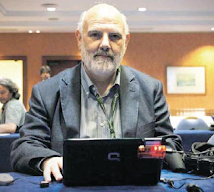
I discovered the work on demography and economics of Swedish Nobel Prizewinner Gunnar Myrdal when I read this paper by Bo Malmberg,Thomas Lindh and Joakim Palme. In that paper they draw attention to the way in which Myrdal was an early pioneer stressing the importance of demographic influences for economic theory, and in particular of how declining population might exert a negative influence on economic performance.
In this sense he was truly a visionary, exploring more than 60 years ago many of the ideas of which I and others have only recently begun to think about (in fact reading Myrdal's lectures I am amazed at how he seems to have gotten through to thinking about just the same issues - like ageing and productivity - which are worrying me right now).
In fact Myrdal seems to have:
1/ Had a major role role in the history of the debate about race relations in the US
2/ With his wife Alva (the mother of modern feminism?) pushed for a series of gender and child friendly policies in Sweden which seem to have given a lot of impetus to the so called 'Swedish model'.
3/ Been the first modern economist to raise the issue that the neo-Malthusians had it wrong about population (in this case the neo-Malthusian Knut Wicksell) and that number wasn't the important issue, but that structure and momentum were.
Myrdal made his population 'discoveries'in the 1930s for the purely conjunctural reason that Sweden was then already suffering from low fertility. As he points out, this was partly a 'structural shock' produced by economic recession and out-migration. But Sweden did have a very early move to the second phase of the demographic transition (the one were birth rates fall below replacement). Sweden's population dynamic has in fact held up fairly well over the last 60 odd years, partly due to inward migration and partly due to child friendly policies. But the long run tendency is making itself felt even in Sweden now.
I have posted the economically relevant Godkin lecture on my website. As a taster, here is a short extract:
Curiously enough, in this neoclassical speculation on population the factor of age distribution was for a long time not studied, and it was never studied intensively as to its economic implications. It is remarkable, because this factor could to a large extent be taken care of in a stationary model of theory. When a certain trend of the population development is maintained for such a long period that a stable age distribution has been reached, the difference between a progressive, a stationary, and a regressive population -- apart from a different development of population numbers -- is that in the first more than in the second, and in the second more than in the third, the number of children is relatively large and the number of old people relatively small. A corresponding difference rules even within each major age group taken by itself. If we thus compare a regressive population with a stationary one, we find that in the first young children are relatively fewer than older ones and that the center of gravity is also higher in middle age as well as in old age.
Now people in different ages are productive in different degrees, and -- within a given standard of living -- their consumptive demands, their cost of living, also differ. Here intensive empirical studies ought to set in, and they are now being made in Sweden, to ascertain the average productivity and the cost of living in different age groups. These calculations give somewhat different results in different social classes. The occupational and cultural changes also alter the quantities from time to time very considerably.
I cannot in this short synopsis enter upon the details of how such realistic studies of agedifferential productivity and cost of living are to be planned and carried out. One very broad generalization must suffice. If, by combining productivity and cost of living into a net productivity, we try to get a general index for the contribution or noncontribution of various age groups, we get, of course, the general picture that normally a person during two periods of his life, the beginning and the end, consumes without producing, while during a period between he produces more than he actually consumes. The influence of its age structure on the average level of living of a nation will then be determined by the relation between the "overproducing" and the "overconsuming" age groups.
continue reading #
Friday, December 02, 2005
The ECB, The Yield Curve and Central Bank Independence
I have just posted on all these topics:
The Most Bizarre Monetary Policy DecisionOf Recent Times?
Central bank independence seems to be once more ’a l’ordre du jour’, and the ECB may well live to find to its cost that there is one thing worse than actually playing the game, it’s playing the game and losing. Now why? Continue reading #
More Pressure on the Yield Curve
One of the things about targeting expectations, and factoring-in changes, is that the world moves on at a very rapid clip these days. So the ECB rate rise in now, really, yesterday's news. The big issue today is the fact that the easing cycle in the eurozone may already be over (we need to see the data going forward before we can be sure about anything here). Continue reading #
Locking Swords
I'd simply love to be a fly on the wall in London this weekend. The G7 finance ministers are about to meet the central bankers, and as in by now well known, these two groups haven't exactly been hitting it off too well lately, at least, and better said, in Germany and Japan they haven't. Continue reading #
The Most Bizarre Monetary Policy DecisionOf Recent Times?
Central bank independence seems to be once more ’a l’ordre du jour’, and the ECB may well live to find to its cost that there is one thing worse than actually playing the game, it’s playing the game and losing. Now why? Continue reading #
More Pressure on the Yield Curve
One of the things about targeting expectations, and factoring-in changes, is that the world moves on at a very rapid clip these days. So the ECB rate rise in now, really, yesterday's news. The big issue today is the fact that the easing cycle in the eurozone may already be over (we need to see the data going forward before we can be sure about anything here). Continue reading #
Locking Swords
I'd simply love to be a fly on the wall in London this weekend. The G7 finance ministers are about to meet the central bankers, and as in by now well known, these two groups haven't exactly been hitting it off too well lately, at least, and better said, in Germany and Japan they haven't. Continue reading #

Wednesday, November 30, 2005
Postponement of Childbearing in Europe
The Vienna Institute of Demography are organising a Conference - Postponement of Childbearing in Europe - between December 1 and December 3 2005. Most of the people with interesting things to say on this topic seem to be attending. I'll get back with more comments on relevant papers as and when they appear online.
Bo Malmberg and The Four Phases of the Demographic Transition
The Swedish demographer Bo Malmberg has offered us a four-phase typology of the demographic transition which is not without interest.
Clearly the impact of the demographic transition on population size and growth rates has been considerable over the last couple of centuries, and it is probably this aspect more than any other that has attracted all the popular attention. Less well appreciated and less well publicised, however, has been the fact that the impact of the transition on the age structure of populations has been an equally strong and significant one.
Further, impacts on age structure tend to be more extended in time. Indeed as I am arguing here, the demographic transition may in fact best be thought of as an extended and continuous process of age-transition. Now, according to Malmberg this age transition consists of four distinct phases, each of them marked by the strong specific weight of one age group. The onset of the transition (which is characterised by a sharp decline in mortality) creates a child phase, then, as fertility begins its decline comes a young-adult one, acceleration of the fertility decline towards replacement fertility produces a phase of population maturity, or adult stage, and finally sustained below-replacement fertility produces in its wake an elderly society.
The first phase of the age transition, the child phase, occurs when falling death rates produce an increase in the number of children. The reason for this increase is fairly self explanatory in that in earlier high-mortality populations, most of those who die are infants and children. Added to this, the process of cohort maturation means that the increasing numbers surviving into adulthood produce yet more children and so on, since the available fertile population grows continuosly, and, with unchanged fertility behaviour, this will inevitably further increase the number of children born.
Continue reading
Clearly the impact of the demographic transition on population size and growth rates has been considerable over the last couple of centuries, and it is probably this aspect more than any other that has attracted all the popular attention. Less well appreciated and less well publicised, however, has been the fact that the impact of the transition on the age structure of populations has been an equally strong and significant one.
Further, impacts on age structure tend to be more extended in time. Indeed as I am arguing here, the demographic transition may in fact best be thought of as an extended and continuous process of age-transition. Now, according to Malmberg this age transition consists of four distinct phases, each of them marked by the strong specific weight of one age group. The onset of the transition (which is characterised by a sharp decline in mortality) creates a child phase, then, as fertility begins its decline comes a young-adult one, acceleration of the fertility decline towards replacement fertility produces a phase of population maturity, or adult stage, and finally sustained below-replacement fertility produces in its wake an elderly society.
The first phase of the age transition, the child phase, occurs when falling death rates produce an increase in the number of children. The reason for this increase is fairly self explanatory in that in earlier high-mortality populations, most of those who die are infants and children. Added to this, the process of cohort maturation means that the increasing numbers surviving into adulthood produce yet more children and so on, since the available fertile population grows continuosly, and, with unchanged fertility behaviour, this will inevitably further increase the number of children born.
Continue reading
Subscribe to:
Posts (Atom)