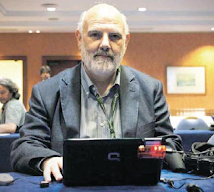
Facebook Blogging

Edward Hugh has a lively and enjoyable Facebook community where he publishes frequent breaking news economics links and short updates. If you would like to receive these updates on a regular basis and join the debate please invite Edward as a friend by clicking the Facebook link at the top of the right sidebar.

Sunday, April 06, 2003

CDMA vs UTMS


One topic which doesn't receive as much comment as it should is the current plight of the UMTS mobile phone situation, and the rapid rise of wCDMA. Two or three years ago we were being told that the technological future of Europe was being guaranteed by its UMTS lead. Whatsmore the superiority of the Brussels based 'central planning' uniform standards model was clearly being demonstrated. Now there's an eery silence. Obviously the small-components-loosely-joined argument was not 'well understood'.


A record-breaking 12 million users signed up for mobile phone services using CDMA technology in the fourth quarter of last year, bringing total CDMA subscribers to nearly 147 million as of the end of 2002, according to the CDMA Development Group (CDG), a US-based trade association. The total figure for CDMA subscribers included 33 million 3G CDMA2000 users, the association said. North America is the biggest CDMA market, with 62 million subscribers. The Caribbean and Latin America market comes in second, with 27 million users. CDMA subscribers in China contributed significantly to CDMA expansion in the Asia-Pacific region, where more than 13 million CDMA subscribers were added last year. Asia also has the highest proportion of 3G subscribers, driven mainly by CDMA2000 services in South Korea and Japan, according to the association. Aiming to penetrate the CDMA market, Nokia unveiled five new CDMA handsets – the 3586i, 6585, 2270, 2275 and 2285 – at the Cellular Telecommunications and Internet Association’s (CTIA) wireless conference in New Orleans last week.Nokia held a 35.8% share in the global handset market last year, but only has about a 10% share of the global CDMA market. South Korea’s Samsung Electronics and LG Electronics (LGE) are the world’s two largest CDMA handset vendors, with approximate 27% and 20% shares of the global market, respectively.
Source: DigiTimes
LINK

More on the IMF and Housing Bubbles


A little more info on the IMF view of the current global housing situation (see next post). This time from the Taipei Times. Conoisseurs of my arguments please note the point about the immigration demographic factor. This argument (to my knowledge) has been used by Alan Greenspan and Glenn Hubbard (in his case to explain why deflation 'isn't a danger') The importance given to the feed through of immigration for new home demand seems to me to be interesting, in particular for what it suggests might be the case if there were no immigration (eg Japan: house prices mired down at mid-eightees levels). Clearly we need more metrics on this, as well as metrics on lead-lags. My feeling is that in a first period (I've seen references to seven years in the sociological research) immigrant labour is largely poor, and sends a significant part of earnings (again the estimate is one third: the IMF does hold numbers on this) back home. This means these workers effectively should be classified as a partial import, with the practical peculiarity that the labour is exercised in the host country (and of course two thirds of the wages are spent there, a not unimportant detail: maybe the other third could be classified as raw material costs!!). The comes a second period, when the immigrant is more focused on life in the new country, ties with family become weaker, and the money going home slows down to a trickle. It is after this transition that the immigrant truly speaking enters the domestic housing market and in forward studies of housing prices and demand this factor needs to be identified and weighted.


The menace of a housing-price bust hovers over Britain, other European countries and possibly even the US, the IMF warned Thursday. Housing prices, even after inflation, had shot up 70 percent in Britain and even further in the Netherlands and Ireland from trough to peak, IMF chief economist Kenneth Rogoff said. "In the United States, where prices are up by 27 percent in excess of inflation since the last trough, the housing price appreciation has been less spectacular," he told a telephone news conference. "But it is still greater than any of the booms we clocked for the United States since 1970," said Rogoff, who was presenting an IMF study on the impact of asset price bubbles. The house price appreciations for all four countries exceeded the IMF statistical definition of a boom, which implied a 40 percent risk of a later bust. "The impact of housing price busts, when they do occur, is much more significant on the real economy, probably double the average impact of an equity price bust," said IMF global economist Jonathan Ostry. "Although equity price busts occur much more frequently, the impact of housing price busts is much more severe," he said. Equity price busts on average occurred every 13 years while housing collapses happened once in 20 years, the IMF study said.Housing price busts on average knocked back gross domestic product -- total economic output -- by 8 percent, it said, compared to 4 percent for stock market collapses. IMF economists hesitated to describe the US housing market as a boom, but they urged the Federal Reserve to monitor it closely. Federal Reserve chairman Alan Greenspan last month played down the risk of a bust. "Clearly, after their very substantial run-up in recent years, home prices could recede," Greenspan told a bankers' convention. "A sharp decline, the consequences of a bursting bubble, however, seems most unlikely."David Robinson, IMF deputy research director, said the scale of the house price increase fell into the IMF statistical definition of a boom but it was too early to declare it a bubble. Immigration had pushed up the US population, and low interest rates had opened housing to more people, stoking demand for housing and suggesting higher prices may be sustainable. "It is something we need to keep our eye very much on in the United States because it is historically high," Robinson said, however. He urged particular caution for regional US housing hot spots. The risk of a housing bust was higher in Britain, given the sharper run-up in prices, IMF analysts said. A house price collapse in one country can have a global impact, the IMF's Rogoff said. "Housing is a significant component of wealth across countries and given that there are linkagaes -- trade, finance, business cycles -- a housing bust in one country will have spillovers to the rest of the world."


IMF Warns on Housing Busts


Oh how wonderful it is not to feel so lonely. First it was Alan Greenspan who started to get interesting on the US social security situation and the state of the refi market. Now it's Ken Rogoff, who once more is confirming that under his stewardship the World Economic Outlook is going to be a 'must' read. This is soooo different from what was coming out ten years ago. If only the OECD could take a leaf from their book - the numbers crunched out may look the same (since the models are more or less similar), but the analysis is light years behind. What makes a good economist is not the capacity to think like a computer, but the capacity to exercise judgement. Looking at the working papers the OECD have some interesting economists on board, so maybe it's time to change the Chief Economist. Incidentally, two more points: I am also not clear that the US situation constitutes a housing bubble. The UK and Spain clearly do. I am merely worried about what will be the consequences of a slowdown in housing in the US for consumer spending, if this happens without an acceleration in capital expenditure. Then we would see the full impact of the March 2000 NASDAQ burst, and this looks like it may now be happening. (Of course one of the difficulties in identifying a bubble may well reside in a lack of agreement about what really constitutes one, even after the event). Which brings me to the second point: the difference between an economist and an index can be seen in the 15% probability assigned to the double dip. I would give it a far higher probability than that, so to all appearances would Stephen Roach and Brad Delong. By their friends shall you know them.

Housing booms such as those in the US and the UK over the past decade are frequently followed by crashes, the International Monetary Fund warns in a forthcoming biannual report on the state of the international economy. Selectively released chapters from the IMF's World Economic Outlook, due out next Wednesday, also warn that excessive corporate debt continues to hold back recovery in the eurozone and the US. But the report also said current debt levels implied only around a 15 per cent chance of another US recession. Ken Rogoff, the fund's chief economist, warned that the long boom in house prices - up 28 per cent in the US since 1996, and 70 per cent in the UK since 1994, adjusted for inflation - put them in danger territory."Forty per cent of all housing booms are followed by busts, with housing price drops that typically average 25-30 per cent," Mr Rogoff said. House prices were more susceptible than stock prices to a bust after a boom, and big economic contractions generally accompanied a crashing housing market, the IMF found.

The IMF also stressed that central banks should continue to monitor house prices as part of their wider assessment of inflationary pressures, rather than target asset prices directly.The new report declined to say whether the US housing market had reached bubble territory. But David Robinson, Mr Rogoff's deputy, said: "It is something we need to keep our eye very much on because it is historically high." A sanguine US Federal Reserve has largely insisted that the size of the US market and the ease of construction make a US housing bubble unlikely. But Bank of England policymakers have expressed more concern at the rapid rise in UK house prices. Elsewhere in its economic outlook, the IMF said that the huge build-up of corporate debt, some of which remained in spite of companies' attempts to deleverage, had held back economic recovery.Mr Rogoff said excessive debt had cut eurozone growth by 2.5-3 percentage points last year, and US growth by up to 1 percentage point. He said it would continue to drag on the recovery this year. But an index that predicted recessions based on corporate leverage and macroeconomic conditions suggested only a 15 per cent chance of a double dip, the IMF said.
Source: Financial Times
LINK

World Cancer Rates Predicted to Rise


This story seems interesting for all sorts of reasons. The report from the WHO is only stating the obvious: more people on the planet will mean more people with cancer. And secondly, an increase in population age structure will mean a higher incidence of cancer. It is a good example of how changing population structures affect us in ways we don't initially think about. Of course, our individual likelihood remains unchanged, but we can feel we know more people with a cancer related illness. Thus our experience of the world can and will change, in this and many other ways. The recent SARS epidemic is another example. While the origin is still unknown, and its precise nature a mystery, it is clear that with more people using more antibiotics, the chances of viral and bacteriological mutation also increase. And with more older people, our demographic vulnerability to things like flu also increases. Lastly, of course, there is the lifestyle component. Do we really live better than our parents? The WHO claim effectively that we don't: this is the poor exercise and fatty food bit. But life expectancy is increasing so this must only be part of the story. Nutrition in the womb, and in early childhood could also be important. So, of course, could genetics. We really don't know how to put weights on all this. So in the meantime accept daddy's advice: quit smoking, eat less industrially processed food, and start walking to work. (By the way, there is of course no special importance about New Zealand cancer rates, it was just a choice of source. This story is being run everywhere).

The World Cancer Report, released by The World Health Organisation (WHO) yesterday, said rates could rise to an alarming 15 million cases with nine million deaths a year by 2020. In 2000, 10 million cancer cases were diagnosed worldwide and six million people died of the disease. The report blames steadily aging populations, high smoking rates, and an unhealthy Western lifestyle rich in fatty foods and poor exercise. It said the trend could be controlled if people changed their lifestyles. WHO cancer researcher and co-author of the report Paul Kleihues said action by governments and the public now could prevent one-third of all cancers, cure another third, and provide care to the remaining third. He predicted cancer rates in developing countries would also increase as they adopted the Western lifestyle. Christchurch Hospital oncology department clinical director Chris Atkinson said New Zealanders had to focus on cutting smoking rates. "We have turned around the number of men smoking but we still have a problem with women smokers," he said. Dr Atkinson said health planners had to "think smart" to address the fact there would be more people with cancer. The public had to decide where to spend precious health dollars, he said. "We desperately need a cancer control strategy. We need better co-ordination of care, including screening, detection, and palliative." Late last year the Government released a draft cancer control strategy that will overhaul New Zealand's treatment and prevention programme. The strategy plans to reduce the advertising of unhealthy food to children, increase the number of smokefree environments, and develop a systematic approach to cancer screening. New Zealand cancer expert Otago University Professor David Skegg said the cancer epidemic did not mean an individual's chance of developing cancer increased.
Source: Stuff.co.nz
LINK