Friday, May 27, 2005
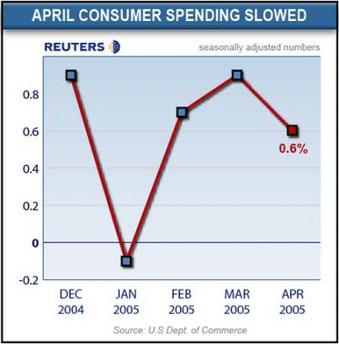
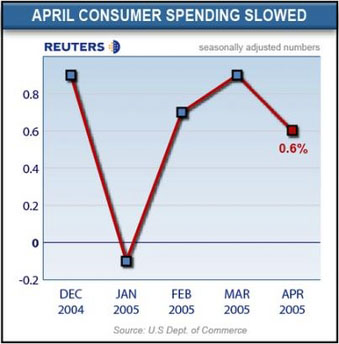
Volatility in US Consumption
A nice graphic showing the current volatility in US consumption. (Courtesy of Reuters)

Disinflation Anyone?
"Stripping out volatile food and energy costs, prices rose just 0.1 percent, the smallest increase since December and a slowdown from a 0.3 percent March advance. Over the 12 months through April, prices were up 1.6 percent, a touch less than in the 12 months ended in March."
So core US consumer price infltion is running at an annual rate of 1.2%. Inflation scare, what inflation scare?
So core US consumer price infltion is running at an annual rate of 1.2%. Inflation scare, what inflation scare?
Andy's Back On Form
Andy, Andy who? Andy Xie, silly:
"The market and media are spinning a new story on China’s currency: the US is ordering China to revalue by more than 10% or face protectionism. Do not hold your breath. China will not buckle. China does not possess the conditions for a strong currency and will not succumb to foreign pressure and take a decision that may cause economic chaos at home.
The noises of protectionism can be deafening these days. The bottom line for protectionism is that the labor in high-cost economies cannot adjust as quickly as capital to seek out lower-cost production locations. This asymmetry may justify temporary and selective trade protection to address the mobility difference between capital and labor. As global companies extend their reach and increase the speed of capital mobility, the cases of targeted protection would increase. However, this would only affect the growth rate of global trade. Such protectionist measures do not imply that the trend of globalization is reversing.
Some argue that the labor backlash in the rich economies may stop or even reverse the trend of globalization. This sort of virulent protectionism did happen in the 1930s. I strongly disagree that the world could head down this path again. Today’s world is dramatically different from that in the 1930s when globalization suffered a severe setback. Modern communications and transportation technologies have dramatically shrunk the world. The interactions in the world community are rising rapidly. Politicians will not be able to stop the trend."
Of course, try telling this to French voters on Monday.
"The market and media are spinning a new story on China’s currency: the US is ordering China to revalue by more than 10% or face protectionism. Do not hold your breath. China will not buckle. China does not possess the conditions for a strong currency and will not succumb to foreign pressure and take a decision that may cause economic chaos at home.
The noises of protectionism can be deafening these days. The bottom line for protectionism is that the labor in high-cost economies cannot adjust as quickly as capital to seek out lower-cost production locations. This asymmetry may justify temporary and selective trade protection to address the mobility difference between capital and labor. As global companies extend their reach and increase the speed of capital mobility, the cases of targeted protection would increase. However, this would only affect the growth rate of global trade. Such protectionist measures do not imply that the trend of globalization is reversing.
Some argue that the labor backlash in the rich economies may stop or even reverse the trend of globalization. This sort of virulent protectionism did happen in the 1930s. I strongly disagree that the world could head down this path again. Today’s world is dramatically different from that in the 1930s when globalization suffered a severe setback. Modern communications and transportation technologies have dramatically shrunk the world. The interactions in the world community are rising rapidly. Politicians will not be able to stop the trend."
Of course, try telling this to French voters on Monday.
Show Your Strength, Not Your Weakness
Well I think this coming climb down was always obvious:
"Even as it publicly pressures China to let its currency rise in value, the Bush administration has quietly softened one of its key demands.
In a calculated shift in tactics, administration officials have stopped demanding that China let it currency, the yuan, float freely against other major currencies. Instead, American officials are telling Chinese leaders that they can keep their policy of a fixed exchange rate if they increase the value of the yuan by 10 to 15 percent.
The policy switch reflects a growing realization that Chinese leaders were simply not going to let their currency soar, which would make their exports more expensive and could disrupt China's troubled banking system.
But the switch also highlights the administration's limited leverage over China".
Maybe they should learn a trick or two from Blair, and try actually getting 'inside the tent'. So if they are demanding 10 - 15%, that means they may get, what, 5 - 10%?
"Even as it publicly pressures China to let its currency rise in value, the Bush administration has quietly softened one of its key demands.
In a calculated shift in tactics, administration officials have stopped demanding that China let it currency, the yuan, float freely against other major currencies. Instead, American officials are telling Chinese leaders that they can keep their policy of a fixed exchange rate if they increase the value of the yuan by 10 to 15 percent.
The policy switch reflects a growing realization that Chinese leaders were simply not going to let their currency soar, which would make their exports more expensive and could disrupt China's troubled banking system.
But the switch also highlights the administration's limited leverage over China".
Maybe they should learn a trick or two from Blair, and try actually getting 'inside the tent'. So if they are demanding 10 - 15%, that means they may get, what, 5 - 10%?
Subscribe to:
Posts (Atom)