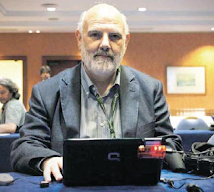
Sorry I haven't been around for a while. I have been tied up by a number of issues which could be loosely described as being associated with my research. The slow roll-out starts again from this post. Which is....
It's strange, but I can't help thinking that in someway or another the launch of windows vista might not mark the begining of the end for Microsoft. These delays are getting to be interesting:
The message from Microsoft this week is "we're on target to ship Windows Vista on schedule, but the schedule may change." The mixed message come as Microsoft takes the wraps off of second-stage beta releases for both Windows Vista and Office 2007.
Of course, now it all depends on Google.(Incidentally, the quality migrate out of hotmail and into gmail is now definitely gaining momentum. And I doubt those who are now leaving will ever be migrating back).
Thursday, May 25, 2006

Monday, May 01, 2006
The Lynx Has No Tail
Welcome to blogland to the Economist's East European correspondant Edward Lucas. Edward has put forward the idea that the EU accession east european 8, if not exactly tigers are, well, certainly lynxes. They are moving forward, that is, at a very fast catch up rate (some faster than others) and are coming chugging up along the value chain.
Claus has been covering this story here (and earlier here and here).
A summary of the study from the Vienna Institute for International Economic Studies which is getting all the attention is available here.
Claus has been covering this story here (and earlier here and here).
A summary of the study from the Vienna Institute for International Economic Studies which is getting all the attention is available here.
Monday, April 24, 2006
Equality, Nature and Culture
I find this article about a study on women's attitudes to housework carried out for Discovery Home and Health site fascinating. Not for any stupid sexist reasons, but because it rings true and has implications:
The Independent daily reported that "even in an age when women are making economic strides and excelling in the workplace, the one thing that gives the majority a sense of empowerment is a good go around the house with the vacuum cleaner -- followed by some cleaning and dusting."
The online study, commissioned by the Discovery Home and Health website, found the average British woman between 18 and 80 spent nine years, two months and 25 days of her waking life cleaning and tidying.
But 59 percent of the women interviewed would have it no other way and said "cleaning makes them feel in control of their lives", while 60 percent said they found it "mentally therapeutic".
Here's the link to the Independent article. The most noteworthy thing is perhaps the point made that whereas "20 years ago housework was seen by many as a sign of female subjugation" nowadays women seem to be freely choosing this activity, moreso, they may even feel that they *need* it.
This takes me directly to one of my more recent theses:
"At the core of the fertility and dual-labour-market transition lies a gender one. Hunter gatherer societies already had a dual labour market, although since this was gender-driven there was only one single fertility regime. Essentially there was a division between 'gathering' (which was principally female or young child oriented) and 'hunting', which needed training (or energy/resource investment) and was male. The transition from this earlier homeostatic regime to the modern fertility longevity trade-off one has been marked by a steady evolution towards gender equality. Modern labour markets are essentially based on formal equality of the sexes in the presence of biological asymmetry. In the long run this is not sustainable and will surely have consequences which are going to be important, but which are, at this stage, difficult to foresee"
Now this gender asymmetry may find *some* alleviation in more equality inside the home (although this will not change the reproductive biology part) but if years of adaptive evolution (whether social or cultural) have lead women so need to undertake certain roles, then remedy may be hard to find. As I say, there will be consequences, even if at this stage what these consequences will be is hard to foresee.
The Independent daily reported that "even in an age when women are making economic strides and excelling in the workplace, the one thing that gives the majority a sense of empowerment is a good go around the house with the vacuum cleaner -- followed by some cleaning and dusting."
The online study, commissioned by the Discovery Home and Health website, found the average British woman between 18 and 80 spent nine years, two months and 25 days of her waking life cleaning and tidying.
But 59 percent of the women interviewed would have it no other way and said "cleaning makes them feel in control of their lives", while 60 percent said they found it "mentally therapeutic".
Here's the link to the Independent article. The most noteworthy thing is perhaps the point made that whereas "20 years ago housework was seen by many as a sign of female subjugation" nowadays women seem to be freely choosing this activity, moreso, they may even feel that they *need* it.
This takes me directly to one of my more recent theses:
"At the core of the fertility and dual-labour-market transition lies a gender one. Hunter gatherer societies already had a dual labour market, although since this was gender-driven there was only one single fertility regime. Essentially there was a division between 'gathering' (which was principally female or young child oriented) and 'hunting', which needed training (or energy/resource investment) and was male. The transition from this earlier homeostatic regime to the modern fertility longevity trade-off one has been marked by a steady evolution towards gender equality. Modern labour markets are essentially based on formal equality of the sexes in the presence of biological asymmetry. In the long run this is not sustainable and will surely have consequences which are going to be important, but which are, at this stage, difficult to foresee"
Now this gender asymmetry may find *some* alleviation in more equality inside the home (although this will not change the reproductive biology part) but if years of adaptive evolution (whether social or cultural) have lead women so need to undertake certain roles, then remedy may be hard to find. As I say, there will be consequences, even if at this stage what these consequences will be is hard to foresee.
Thursday, April 20, 2006
The IMF and Dollar Depreciation
I have a post on Demography Matters which while ostensibly being about Iceland is in fact unavoidably about the global imbalances situation and how such imbalances may or may not 'correct' in the light of our current demographic realities. The heart of this issue is really whether there is any straightforward and 'classic' way to address the US current account deficit. Brad Setser and Nouriel Roubini have of course been in the forefront of urging the 'dollar correction' remedy. I see from the FT this morning that the IMF has now added its voice to the chorus:
"The International Monetary Fund on Wednesday stepped up the pressure for far-reaching shifts in exchange rates, declaring that the dollar will have to depreciate “significantly” over the medium term if global economic imbalances are to be resolved in an orderly fashion."
I guess this would be the point: "if global economic imbalances are to be resolved in an orderly fashion".
I seriously question whether any such shifts are possible, especially in the medium term where Geramny Italy and Japan's problems can only increase not decrease.
The IMF obviously mention the Asian currencies, but as the FT notes "it shied away from giving any specific figures as to the extent of appreciation required".
My personal feeling is that they are wise to refrain from so doing. Clearly *some* Asian currencies can steadily appreciate, but at a rate which will not resolve the imbalances issue appreciably, others (like the Tigers) are themselves rapid agers, and will have their own issues.
What, I think, we need to keep very clearly in mind here is not the relative size of the various populations, but the relative values of the GDPs (both per capita and in absolute terms).
I think a lot of people are now way out of their depth in all of this. A key component of the current IMF view would seem to be this:
"The IMF sharply increased its estimates for growth in Japan, to 2.8 per cent this year and 2.1 per cent next, declaring that the expansion there is now “well-established”."
Of course, if the IMF are right that the Japanese expansion is now 'well established' then the picture begins to change, but I think there are plenty of grounds for serious doubt that it is, and if it isn't, then it'll be another kind of correction that we are about to see.
I think the core of what I am saying is that many of these problems are fairly complex and hard to handle. Simplistic solutions, and platitudes (which is what I think the IMF are going in for) just don't contribute anything useful.
There is always a trade-off.
If what you really think is the most important thing in the short to mid term is correcting the US CA deficit, then Bernanke simply needs to continue doing what he is already doing and keep raising rates. In the short term this will push the dollar even higher, but as it grinds down growth in the US it will begin the correction in the CA deficit. The issue is whether or not you think the price is worth paying.
Ditto the Federal Deficit, reducing this may or may not help the CA deficit, but it would reduce growth in the US, which would indirectly help, but only at the cost of making those who are already worried about a weak labour market even more worried.
Bottom line, the IMF WEO was on a much better level when Rogoff was Chief Economist, and the BIS publications seem to be a much better read these days, as they seem to be getting much nearer the core of what globalisation really means.
"The International Monetary Fund on Wednesday stepped up the pressure for far-reaching shifts in exchange rates, declaring that the dollar will have to depreciate “significantly” over the medium term if global economic imbalances are to be resolved in an orderly fashion."
I guess this would be the point: "if global economic imbalances are to be resolved in an orderly fashion".
I seriously question whether any such shifts are possible, especially in the medium term where Geramny Italy and Japan's problems can only increase not decrease.
The IMF obviously mention the Asian currencies, but as the FT notes "it shied away from giving any specific figures as to the extent of appreciation required".
My personal feeling is that they are wise to refrain from so doing. Clearly *some* Asian currencies can steadily appreciate, but at a rate which will not resolve the imbalances issue appreciably, others (like the Tigers) are themselves rapid agers, and will have their own issues.
What, I think, we need to keep very clearly in mind here is not the relative size of the various populations, but the relative values of the GDPs (both per capita and in absolute terms).
I think a lot of people are now way out of their depth in all of this. A key component of the current IMF view would seem to be this:
"The IMF sharply increased its estimates for growth in Japan, to 2.8 per cent this year and 2.1 per cent next, declaring that the expansion there is now “well-established”."
Of course, if the IMF are right that the Japanese expansion is now 'well established' then the picture begins to change, but I think there are plenty of grounds for serious doubt that it is, and if it isn't, then it'll be another kind of correction that we are about to see.
I think the core of what I am saying is that many of these problems are fairly complex and hard to handle. Simplistic solutions, and platitudes (which is what I think the IMF are going in for) just don't contribute anything useful.
There is always a trade-off.
If what you really think is the most important thing in the short to mid term is correcting the US CA deficit, then Bernanke simply needs to continue doing what he is already doing and keep raising rates. In the short term this will push the dollar even higher, but as it grinds down growth in the US it will begin the correction in the CA deficit. The issue is whether or not you think the price is worth paying.
Ditto the Federal Deficit, reducing this may or may not help the CA deficit, but it would reduce growth in the US, which would indirectly help, but only at the cost of making those who are already worried about a weak labour market even more worried.
Bottom line, the IMF WEO was on a much better level when Rogoff was Chief Economist, and the BIS publications seem to be a much better read these days, as they seem to be getting much nearer the core of what globalisation really means.
Subscribe to:
Posts (Atom)