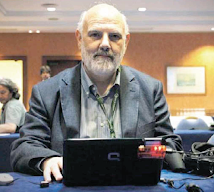
Here's a new take on the 'living in interesting times' theme: the curse is really that with so many interesting things going-off its hard to concentrate sufficiently on any one of them. The latest case in point is Robert, who wrote me about the size of an acre, and indirectly pointed me towards the work of Paul Colinvaux. As can be seen from the photo, he must undoubtedly be a man after my own heart.
Colinvaux's work is ecological, and he is, of course, interested in population dynamics. Equally interesting, he seems to have attracted the attention of fellow Bonobo enthusiast William H Calvin. Calvin discusses Colinvaux's work in The River That Flows Uphill, which is his river diary of a two-week whitewater trip through the bottom of the Grand Canyon. Again, well worth the read.
Thursday, November 17, 2005
Wednesday, November 16, 2005
Fertility Among Foragers and Agriculturalists
Now here's an interesting paper from karen kramer and james boone: Why Intensive Agriculturalists Have Higher Fertility: A Household Energy Budget Approach.
Basically Kramer and Boone look at comparative fertility rates in foraging and agricultural societies:
"It is widely held that human population growth rates began to increase markedly after the Pleistocene/Holocene transition largely as a consequence of the adoption of agriculture and sedentism. A common explanation for this increase in growth rates has been that circumstances associated with food production and/or the accompanying decrease in mobility allowed for higher fertility rates, but over the past decade a number of empirical studies and simulation analyses have revealed that the relationship between mode of subsistence and fertility is more complex than had previously been realized."
"In 1988, Campbell andWood published a cross-cultural compilation of total fertility rates (TFR) of 70 forager, horticultural, and intensive agricultural societies from the contemporary ethnographic record that showed no significant differences in TFRs across subsistence regimes. Hewlett (1991) published a similar analysis of 40 mobile and sedentary foragers and pastoralists that indicated slightly higher fertility rates among pastoralists, although the difference was not significant. In 1993, Bentley et al. published an extensive critique and reanalysis of the Campbell and Wood study, presenting a new cross-cultural comparison of 57 forager, horticultural, and intensive agricultural groups (Bentley, Jasien-ska, and Goldberg 1993, Bentley, Goldberg, and Jasienska 1993). Using a subset of the Campbell andWood sample, excluding nonindependent cases (ethnic groups that were closely related) and populations with high levels of sterility, they found that intensive agriculturalists had significantly higher fertility rates. Interestingly, however, horticulturalists showed slightly lower fertility than foragers in the sample, although the difference was not significant. Using a similar kind of data base, Sellen and Mace (1997) have shown that for every 10%increase in dependence on agriculture there is a 0.4 increase in TFR."
Now a number of points seem to clearly stand out here. Firstly, fertility generally in foraging (hunter/gatherer) societies is not especially high: Hewlett finds a mean TFR of 5.6 with a range of 3.5 - 7.9, while Bentley, Goldberg, and Jasienska find a mean for agriculturalists of 6.6 with a range of 3.5 to 9.9. So fertility in agricultural societies is somewhat higher, now why the difference? Now as Kramer and Boone state circumstances associated with food production and/or the accompanying decrease in mobility might have been thought to account for the difference, but apparently not. So what was it?
"This paper explores the idea that children’s contribution to underwriting the cost of large families may be an important factor conditioning variation in family size and the higher fertility attained by at least some intensive agriculturalists."
In other words it was the role of children as a source of cheap labour which drove the additional fertility. Well, what'd'yu know. Definitely worth a read.

The Full Cantillon Post is Worth Reading
As I suspected, Cantillon didn't write exactly what many have subsequently attributed to him:
In the lower classes of the state also there are men who from pride and from reasons similar to those of the nobility, prefer to live in celibacy and to spend on themselves the little that they have rather than settle down in family life. But most of them would gladly set up a family if they could count upon keeping it up as they would wish: they would consider themselves to do an injustice to their children if they brought them up to fall into a lower class than themselves. Only a few men in a state avoid marriage from sheer flightiness. All the lower orders wish to live and bring up children who can live like themselves. When labourers and mechanics do not marry it is because they wait till they save something to enable them to set up a household or to find some young woman who brings a little capital for that purpose, since they see every day others like them who for lack of such precaution start housekeeping and fall into the most frightful poverty, being obliged to deprive themselves of their own food to nourish their children.
From the observations of Mr Halley, at Breslaw in Silesia, it is found that of all the females capable of child bearing, from 16 to 45 years of age, not one in six actually bears a child every year, while, says Mr Halley, there ought to be at least 4 or 6 who should have children every year, without including those who are barren or have still births. The reason why four women out of six do not bear children every year is that they cannot marry because of the discouragements and difficulties in their way. A young woman takes care not to become a mother if she is not married; she cannot marry unless she finds a man who is ready to run the risk of it. Most of the people in a state are hired or are undertakers; most are dependent and live in uncertainty whether they will find by their labour or their undertakings the means of supporting their household on the footing they have in view. Therefore they do not all marry, or marry so late that of six women, or at least four, who should produce a child every year there is actually only one in six who becomes a mother.
The increase of population can be carried furthest in the countries where the people are content to live the most poorly and to consume the least produce of the soil. In countries where all the peasants and labourers are accustomed to eat meat and drink wine, beer, etc. so many inhabitants cannot be supported.
Men multiply like mice in a barn if they have unlimited means of subsistence; and the English in the colonies will become more numerous in proportion in three generations than they would be in thirty in England, because in the colonies they find for cultivation new tracts of land from which they drive the savages.
A state which has conquered several provinces may, by tribute imposed on the vanquished, acquire an increase of subsistence for its own people. The Romans drew a great part of their subsistence from Egypt, Sicily and Africa and that is why Italy then contained so many inhabitants.
A state where mines are found, having manufactures which do not require much of the produce of the land to send them into foreign countries, and drawing from them in exchange plentiful merchandise and produce of the land, acquires an increased fund for the subsistence of its subjects.
The Dutch exchange their labour in navigation, fishing or manufactures principally with foreigners, for the products of their land. Otherwise Holland could not support of itself its population. England buys from abroad considerable amounts of timber, hemp and other materials or products of the soil and consumes much wine for which she pays in minerals, manufactures, etc. That saves the English a great quantity of the products of their soil. Without these advantages the people of England, on the footing of the expense of living there, could not be so numerous as they are. The coal mines save them several millions of acres of land which would otherwise be needed to grow timber.
It is also a question outside of my subject whether it is better to have a great multitude of inhabitants, poor and badly provided, than a smaller number, much more at their ease: a million who consume the produce of 6 acres per head or 4 million who live on the product of an acre and a half.
Essai sur la nature du commerce en general
Part One: Chapter Fourteen The Fancies, the Fashions, and the Modes of Living of the Prince, and especially of the Landowners, determine the use to which Land is put in a State and cause the variations in the Market price of all things
Cantillon, Mice and China
I am rumaging around trying to find the source of the Cantillon quote:
"Men multiply like mice in a barn if they have unlimited means of subsistence"
I have found it, and the idea behind the quote is, of course, interestingly wrong. It is wrong for self-evident reasons, and it is interesting for the lasting impact it has had on the way some economists see demography and fertility. (More on all this soon, but meantime you can find Cantillon's Essai Sur La Nature Du Commerce En General here).
However, I couldn't help noticing the similarity between what Richard Cantillon argued 250 years ago, and the latest OECD report on Chinese agriculture (see previous post and - plus ça change!).
There is no country where population is carried to a greater height than in China. The common people are supported by rice and rice water; they work almost naked and in the southern provinces they have three plentiful harvests of rice yearly, thanks to their great attention to agriculture. The land is never fallow and yields a hundredfold every year. Those who are clothed have generally clothing of cotton, which needs so little land for its production that an acre of land, it seems, is capable of producing a quantity full sufficient for the clothing of five hundred grown up persons. The Chinese by the principles of their religion are obliged to marry, and bring up as many children as their means of subsistence will afford. They look upon it as a crime to lay land out in pleasure gardens or parks, defrauding the public of maintenance. They carry travellers in sedan chairs, and save the work of horses upon all tasks which can be performed by men. Their number is incredible if the relation of voyages is to be depended upon, yet they are forced to destroy many of their children in the cradle when they apprehend themselves not to be able to bring them up, keeping only the number they are able to support. By hard and indefatigable labour they draw from the rivers an extraordinary quantity of fish and from the land all that is possible.
Nevertheless when bad years come they starve in thousands in spite of the care of the emperor who stores rice for such contingencies. Numerous then as the people of China are, they are necessarily proportioned to their means of living and do not exceed the number the country can support according to their standard of life; and on this footing a single acre of land will support many of them.
Guessing that 0.65 hectares is around an acre, this seems to be the case: "Fully 200m of China’s 248m rural households farm on plots of land of around 0.65ha".
OECD 2005
Update: Robert "the rattlesnake" has just mailed me pointing out the following:
0.65 hectare is 1.6 acres
One hectare is 2.5 acres (actually close to 1% less)
and 1 acre is 0.4 ha (actually a little over 1% more)
In passing I would add two unrelated comments. Firstly I have comments switched off since Blogger has been attracting one hell of a lot of spam, and since posts which may be more likely to attract comments and discussion go on A Fistful of Euros (or Afem) anyway. Secondly, can I recommend Robert's interesting looking tour de force: Choice and Constraint.
Subscribe to:
Posts (Atom)