The price of crude leaped to a new high this morning (Monday), breaking through the psychologically important US$60 a barrel threshold as concerns mounted that supply would not meet demand, especially in the United States. This is leading some (including the FT) to ask whether push is coming to shove on the cost side (equally it won't exactly be good news for consumption).
Shares in energy-intensive companies such as manufacturing and transport were hardest hit. FedEx, for example, the US delivery group that has been a leading beneficiary of booming global trade, broke its winning streak by warning that this quarter's earnings would be hit by jet fuel costs despite an automatic surcharge for customers.
And the metals industry, which had been enjoying its best growth for years, is now squeezed between the high cost of energy-related inputs such as electricity and coal and slowing demand from leading customers.
Monday, June 27, 2005

Wen Gives Market Guidance On Renminbi
China's premier - Wen Jiabao - put the world on warning yesterday that there will be no "undue haste" in the introduction of a more flexible exchange rate for China. Whether this is the result of the incompetent way this issue has been handled at the political level, or whether this was always going to be this way, China is now making clear that *she* will decide.
"Before representatives of more than 40 countries, Mr Wen reaffirmed China's longstanding commitment to move to a more flexible system, without disclosing when and how the change would be made. "By 'gradual progress', we mean to push forward the reform in a step- by-step manner. . . .and guard against undue haste," Mr Wen said.
"However, since this reform involves a wide range of areas and will have a far-reaching impact, it still requires a great deal of preparation to help create an enabling environment for all sides to sustain the possible impacts."
Mr Wen listed a lengthy set of considerations guiding policy on the renminbi, including its impact on domestic economic growth, job creation, financial stability, foreign trade and the ability of local companies to manage currency risk.
At the end of this list, Mr Wen said China would also "keep an eye on the economic and financial performance of neighbouring countries and regions, and of the world as a whole".
"Before representatives of more than 40 countries, Mr Wen reaffirmed China's longstanding commitment to move to a more flexible system, without disclosing when and how the change would be made. "By 'gradual progress', we mean to push forward the reform in a step- by-step manner. . . .and guard against undue haste," Mr Wen said.
"However, since this reform involves a wide range of areas and will have a far-reaching impact, it still requires a great deal of preparation to help create an enabling environment for all sides to sustain the possible impacts."
Mr Wen listed a lengthy set of considerations guiding policy on the renminbi, including its impact on domestic economic growth, job creation, financial stability, foreign trade and the ability of local companies to manage currency risk.
At the end of this list, Mr Wen said China would also "keep an eye on the economic and financial performance of neighbouring countries and regions, and of the world as a whole".
Wednesday, June 22, 2005
Quick Housing Review
Mathew Lynn of Bloomberg has a reasonable run-around the UK housing situation. I agree with this "A sharp decline is now more likely. And a housing slump may well lead the economy into its first recession this decade".
The Economist is also fretting about housing (as it has been for some time now).
One other big difference between houses and shares is more cause for concern than comfort: people are much more likely to borrow to buy a house than to buy shares. In most countries, the recent surge in house prices has gone hand-in-hand with a much larger jump in household debt than in previous booms. Not only are new buyers taking out bigger mortgages, but existing owners have increased their mortgages to turn capital gains into cash which they can spend. As a result of such borrowing, housing booms tend to be more dangerous than stockmarket bubbles, and are often followed by periods of prolonged economic weakness. A study by the IMF found that output losses after house-price busts in rich countries have, on average, been twice as large as those after stockmarket crashes, and usually result in a recession.
The Economist also publishes a global house price index, here is the latest version.
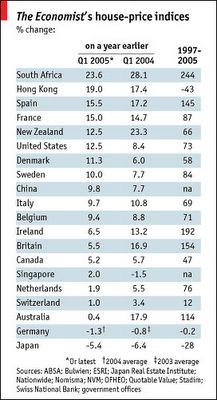
Apart from the fact that the boom in the Netherlands, the UK and Australia has now clearly broken, note the performance in key ageing economies like Germany and Japan, where property values have been falling for some time now, and Switzerland, where they are about to. One other surprising detail is Italy, where y-o-y is still at 9.7% despite the protracted recession. Just watch what happens when it follows the 'ageing' trajectory. (Spain will too, in my opinion, but that is out there in the future , and another story).
The Economist is also fretting about housing (as it has been for some time now).
One other big difference between houses and shares is more cause for concern than comfort: people are much more likely to borrow to buy a house than to buy shares. In most countries, the recent surge in house prices has gone hand-in-hand with a much larger jump in household debt than in previous booms. Not only are new buyers taking out bigger mortgages, but existing owners have increased their mortgages to turn capital gains into cash which they can spend. As a result of such borrowing, housing booms tend to be more dangerous than stockmarket bubbles, and are often followed by periods of prolonged economic weakness. A study by the IMF found that output losses after house-price busts in rich countries have, on average, been twice as large as those after stockmarket crashes, and usually result in a recession.
The Economist also publishes a global house price index, here is the latest version.
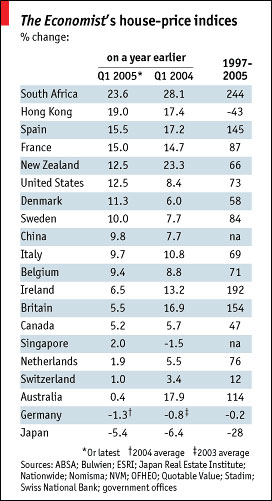
Apart from the fact that the boom in the Netherlands, the UK and Australia has now clearly broken, note the performance in key ageing economies like Germany and Japan, where property values have been falling for some time now, and Switzerland, where they are about to. One other surprising detail is Italy, where y-o-y is still at 9.7% despite the protracted recession. Just watch what happens when it follows the 'ageing' trajectory. (Spain will too, in my opinion, but that is out there in the future , and another story).
Copper On The Rise
Andy Xie was talking last week about a China driven oil price bust. I find the argument less and less convincing. China's growth rate may well slacken, but other important economies are also growing rapidly and could well take up some of the slack. Meanwhile commodity prices show no sign of imminent collapse:
"Copper futures rose in Shanghai after global inventories fell to their lowest in three decades, fueling concern about scarce supplies and driving prices higher in New York and London. Cash copper prices also rose.
Inventories monitored by the London Metal Exchange fell 600 metric tons to 33,900 tons, the exchange said yesterday. That's the lowest since July 1974 and equals less than one day of global consumption, forecast at 17.4 million tons this year by the Lisbon-based International Copper Study Group. Stockpiles have fallen 69 percent in the past 12 months.
``Low stockpiles are the main reason for the price rally,'' Gu Yuan, a metals trader with Shenzhen Star Futures Co., said by telephone from Shanghai."
"Copper futures rose in Shanghai after global inventories fell to their lowest in three decades, fueling concern about scarce supplies and driving prices higher in New York and London. Cash copper prices also rose.
Inventories monitored by the London Metal Exchange fell 600 metric tons to 33,900 tons, the exchange said yesterday. That's the lowest since July 1974 and equals less than one day of global consumption, forecast at 17.4 million tons this year by the Lisbon-based International Copper Study Group. Stockpiles have fallen 69 percent in the past 12 months.
``Low stockpiles are the main reason for the price rally,'' Gu Yuan, a metals trader with Shenzhen Star Futures Co., said by telephone from Shanghai."
Subscribe to:
Posts (Atom)