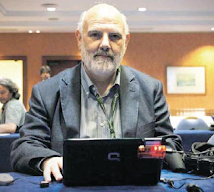
Fresh back from the holidays with the resolution to make some changes. Here's the first. My fotopages fotolog. These are my first set of holiday snaps for those with more time than they have good sense. The Serge in one of the photos is the - now retired - French farmer in whose farmhouse we stay. He's a lovely man - the sort they don't make any more - and as well as his company we enjoy the pleasures of his 'own brand' - no chemicals here - wine, and those small round French Cantaloupe melons that come from his land. Clearly I could have gone to the trouble of putting these on the website. But I am a strong believer in the law of least effort. So maybe with a simple tool like this I will be tempted to post photos more often. Is this a threat or a promise. Be kind to me.
Monday, August 25, 2003

Europe on the Japenese Road Map
Strong article from Anatole Kaletsky this. I wouldn't go along with his tongue in cheek optimism about the UK and the US, but on the danger of what he calls the media cliché of Germany being the prinicipal deflation candidate (I think you will find I was saying this here and on Bonobo Land long before it became fashionable to do so) I think he is bang on target. Also exceptional is his recognition that: "Cutting unemployment pay, reducing job protection and scaling back pensions can accelerate economic growth in an economy where demand is growing. But in an economy suffering from long-term demand stagnation, even the talk of such harsh supply-side reforms is likely to damage consumer confidence and further undermine demand." This is a point - like voices in the wilderness - Eddie Lee and I have been trying to hit home for some time. The srtuctural reforms are necessary, but everything is timing and mix, and if you don't get these right you're more likely to sink Germany further than to do anything constructive. Germany is an ageing and apprehensive society:
Last week's figures confirmed that the German, Italian and Dutch economies have all entered their second or third quarters of economic decline, and that the eurozone as a whole was stagnant for the ninth consecutive month, with most industrial indicators pointing to further weakness ahead. Despite all this grim news, investors are bidding up share prices across Europe, Germany has been the best performing major stock market in the world this year and the euro remains cripplingly expensive against the pound, yen and dollar, not to mention the Chinese renminbi - as anyone who has been on holiday in Europe this year can attest.
This divergence between market behaviour and economic reality can have one of two consequences. Either the eurozone economy will soon start to perform much better than the present statistics are suggesting; or investors in euro assets will soon realise that they are caught up in another asset bubble in some ways even more irrational than the dot-com speculation of the 1990s or the bond bubble that imploded so spectacularly two months ago. There are several reasons why the outlook for Europe today looks considerably worse than it did for Japan in the mid-1990s, when its economy lurched from cyclical recession to structural depression. The first is the paralysis of monetary and fiscal policy as a result of the single currency project. The monetary response to economic stagnation in Europe is proving even more timid than it was in Japan.
The European Central Bank has consistently dragged its feet and aggravated the recession, to the point where investors actually expect an increase in European interest rate next year. Compare this to what happened in Japan after the yen shock of 1995. Japan had already reduced its interest rates to 2 per cent a year before the yen shock hit in early 1995. From that point on the Bank of Japan became much more aggressive, slashing three-month rates to zero in six months (see bottom chart). Does anyone seriously expect the ECB to act so decisively in the next six months? Fiscal policy will provide even less support for the euroland economy. European budgets are already in deficit, and fiscal policy is prevented by the Stability Pact from playing an active stabilising role. Japan managed to avoid a deep depression in the late 1990s because government spending kept the economy afloat, providing a net stimulus of almost 1 per cent of GDP each year between 1995 and 1999.
In euroland, the fiscal stimulus will be nil in the next few years - even on the optimistic assumption that Germany and France continue to ignore the Maastricht treaty's insane strictures to reduce budget deficits when they ought to be expanding. Meanwhile, the euro has become almost as overvalued as the yen was in 1995. In fact export prospects for Europe are now even bleaker than they were for Japan in the 1990s. Japan's net exports grew rapidly from 1996 until 2000, providing the economy with its main source of growth. But Japan was able to increase its trade surplus only because America was allowing its trade deficit to expand. Combining the influences of fiscal policy and trade, we can see that Japan was saved from depression in the late 1990s by a widening of budget deficits and export surpluses, which added more than 1 per cent to GDP growth each year.
Europe now faces exactly the opposite macroeconomic outlook. The budget deficit will be stable at best and may even narrow, if governments are mad enough to follow the instructions of the European Commission and the ECB. At the same time, euroland's current account will shift towards deficit by 1 to 2 per cent of GDP. Thus Europe is carrying a much heavier handicap in the global deflation stakes than Japan did in the 1990s. But what about economic reforms? Surely the Europeans are finally getting the message about deregulating labour markets, cutting taxes, strengthening competition and trimming their welfare states?
There are some grounds for greater optimism in this area, especially in Germany, where Gerhard Schroeder's Agenda 2010 programme is proving surprisingly successful in introducing some modest labour market reforms. But structural reforms, in the absence of a positive monetary and fiscal policy, can be worse than useless. Cutting unemployment pay, reducing job protection and scaling back pensions can accelerate economic growth in an economy where demand is growing. But in an economy suffering from long-term demand stagnation, even the talk of such harsh supply-side reforms is likely to damage consumer confidence and further undermine demand.
This is another of the key lessons from Japan. With an aggressively growth-oriented monetary and fiscal policy (of the kind seen in the US and Britain since the early 1990s) labour market reforms can create new jobs and win public support, but in the absence of a clear commitment from the central bank and the government to keep demand growing, supply-side reforms simply put people on the dole. Yet in Europe, the institutions that created the euro have made the co-ordinated changes in monetary, fiscal and structural policies almost impossible, even if the reform movement starts to command strong political support. This is at the heart of the long-term economic problems faced by the eurozone.
Japan became a laughing stock in the last decade because of the inability of its politicians, bureaucrats and central bankers to agree on the economic reforms that were clearly required. But Japan's challenge in creating consensus is nothing compared with the nightmare of creating co-operation among the warring institutions of the eurozone. The ECB is a far more independent central bank than the BoJ ever could be. The European Commission, even more than the Japanese bureaucracy, is a self-serving institution that pursues its own agenda, regardless of what elected politicians may say.
The eurozone has 12 governments, which between them include roughly 50 coalition parties, as against the single government (more or less) in Japan. This means that Japanese-style problems of fiscal, monetary and political co-ordination must be multiplied by 12 in Europe, or maybe raised to the twelfth power. Investors around the world are betting that Europe is suffering nothing worse a standard cyclical downturn and will soon recover to become the healthiest economy in the world. They could turn out to be right. But remember: that is what everybody thought about Japan in 1995.
Source: The Times
LINK
Is 'Speculation' Back?
Barry the Big Picture has been on tv . He also has a useful link to a piece - which also quotes him - in Business 2.0. The point in question: is the current NASDAQ mini-revival a little bit of midsummer madness?
They're back. "It" stocks--the hot issues that defy all the laws of fundamental investing--have reappeared. These are the kinds of stocks that seem to keep heading higher for no other reason than that they finished higher the day before. Search engine Ask Jeeves is up 570% in 2003. Money-losing XM Satellite Radio is up 400%. And unprofitable biotech ImClone Systems (better known for the insider trading scandal that landed founder Sam Waksal in jail) is up 300%. Sure, none are likely to surpass the 2,620% gain of quintessential "it" stock Qualcomm in 1999. But it's beginning to look as though investors are getting caught up in the momentum mania that characterized the final gasps of the bull market.
Just look at these stats: The Nasdaq has gained 29% this year (through July 30) and is up 54% from its Oct. 9, 2002 low. (Standard & Poor's 500-stock index is up about 28% from its low.) According to Thomson/Baseline, 119 companies with a market value of at least $500 million have doubled this year; nearly 40% of them are not expected to post a profit in 2003. And shares of companies (also with a minimum market value of $500 million) that don't pay dividends were up an average of 46% vs. a 16% average gain for those that do. "The companies that have run the most are the ones that have the least [to offer]," says Jeffrey Saut, chief investment strategist for Raymond James. "Speculation is back."LINK
The China Fringe
Two China-related blogs (China-related since neither of them is in fact located inside mainland China) are the Hong Kong based Gweilodiaries and Taiwan Blogger A Better Tommorrow (this latter name comes from the title of a John Woo film). Both are preoccupied right now about the lifestyle consequences of China's re-unification ambitions. Conrad the Gweilo ( apart from sharing my new found interest in posting photos) is non too happy with what he sees as attempts by Zou Zhekai, deputy director of the central government's liaison office in Hong Kong, to gag him and other representatives of the Hong Kong 'media community' in terms of their right to opinion over the future of Taiwan. Zou, it seems, bases himself on a very special interpretation of the notion of 'loyalty' under the currently reigning 'Basic Law'
Evidently Conrad is in danger of being accused by the Chinese authorities of being 'fair and balanced'. Better Tommorrow is also preoccupied about the future of Taiwan, and more than a little fascinated by the ROC vice president Anette Lu:Zou's statement is stunning in that, to Beijing, 'one country, two systems' appears to mean: (1) reunification with Taiwan, under CCP rule, and (2) that Hong Kongers are required to support Beijing's interpretation. Perhaps Mr. Zou would care to point out where either of those principles appear in the Basic Law. To the extent this humble little blog constitutes part of the Hong Kong media, may I just say Mr Zou, if that's your definition of 'one country, two systems', I most assuredly do not support it. Indeed, I oppose it, support a free and independent Taiwan and independence for Tibet and Uighar as well. I suppose this makes me "not good." Fortunately, absent Beijing's cherished Article 23 legislation, you lack the means to punish me for my insubordination. Is anyone still haboring doubts about the intended use of the proposed subversion and succession laws?
So BT shares my feeling for irony and sarcasm! But apart from their mutual concern about 'big mother' ambitions, there are also 'little daughter' ones to worry about, and I can't help feeling that both Conrad and Better Tomorrow seem to be unduly interested in the strange phenomenon of Betel Nut Girls. Maybe my problem is age, or maybe it's cultural perspective. This notwithstanding BT makes some interesting comparisons about life in Taiwan and life on the mainland, although my end of the day feeling may be that this tells you as much about being young and having grown up in the 'good-ol' US of A as it does about close cultural detail Taiwan-style.As much as I like someone who speaks their mind, especially when it's unpopular, Lu is either ridiculously naive, frustratingly disingenous, or just outright insane with some of her statements about Taiwanese independence. I would much prefer it if, instead of fire and brimstone, she used sarcasm and irony. Oh man, I'd have a field day if I were vice-president of Taiwan. I'd call press conferences and use finger quotation marks while talking about all the wonderful benefits of reuniting with the motherland.
LINK
The main difference between Taipei and the other large cities in the mainland that I've been to is that Taipei just feels so much more organic. For instance, I walked around Ximen for a bit, which is a fancy shopping area with crazy hot girls all over the place and J-pop blaring out of every store. Then I headed south and hit this hardcore Taiwanese nieghborhood with all of these Buddhist temples and Christian churches and night market stalls getting set up and old people walking around, shooting the shit in Taiwanese. You can find lots of bright, shiny areas like Ximen in the mainland (Xinjiekou in Nanjing, Xin Tiandi in Shanghai, Wangfujing in Beijing). But they feel so empty and sterile, like the city government ordered their construction not because there was any demand for luxury shopping (that mall in Beijing at the intersection of Wangfujing and Chang'an jie is probably the worst offender: one empty luxury qipao store after another) as if just by building the stores that they'd become a Tokyo or Milan. The fuwuyuan to customer ratio at these places can be depressingly high. The layout of Taipei, while not the most orderly, feels like it sprung up organically to serve the needs of the residents, as opposed to many mainland cities, which feel like the planners are doing everything in their power to force modernity in and destroy anything of historical value..............
I finally had my first pearl milk tea in Taiwan. It really was off the hizzle, my nizzle. It was smooth and sweet and actually tasted like milk tea. The tapioca balls also were sweet and had a really nice consistency. How could I spend a year in Nanjing, drink dirty dishwater filled with flavorless rubber balls, and claim that I knew anything about zhenzhu naicha? For shame. While I'm in Taiwan, not a day will go by where I go without a cup of sweet, sweet pearl milk tea.
LINK